 |
|
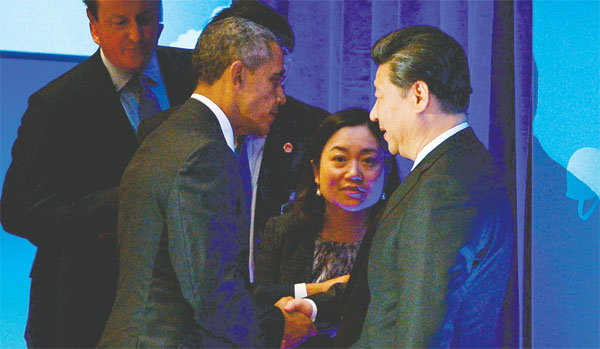
US President Barack Obama and China's President Xi Jinping shake hands at the Peacekeeping Summit at United Nations headquarters on Monday. [Photo/Agencies] |
President Xi Jinping has just completed a state visit to the United States, accomplishing much of his mission: Sino-US mutual reassurance on maintaining the status quo in the Asia-Pacific region and mutual recommitment to "a new model of major-country relationship".
Just before his visit, the US seemed quite wary of China's strategic intentions, especially Beijing's move in the South China Sea, the Belt and Road Initiative, and the Asian Infrastructure Investment Bank, not to mention the alleged hacking of US systems by China. For a while, there was concern that China-US ties had reached a critical juncture that could lead to confrontation.
The essence of a summit is the one-on-one meeting between the heads of state to, among other things, clarify strategic intents and offer strategic reassurance. Xi's visit attained these objectives.
The summit concluded with China respecting the US' traditional influence and interests in the Asia-Pacific, and welcoming its positive and constructive role in the region. The US, on its part, welcomed China's rise as a powerful regional and global player. There couldn't be better reassurance than this.
So long as the two permanent members of the UN Security Council remain committed to building stronger bilateral ties, there will be more such reassurances, which will also consolidate global and regional peace, stability and prosperity.
To reach this stage, Washington and Beijing have agreed to remain committed to fighting cyber-threat to protect both business interests and government secrets. The two sides addressed many cyber-and business-related issues to foster innovation at the entrepreneur and technology levels. Business circles across the Pacific should feel encouraged by the common will of the two leaders.
At a time when the US is still adjusting its economy and China is transforming itself through its economic "new normal", it is crucial for the two largest economies to avoid misunderstandings and misjudgments, especially at strategic level. The US may have reasons to highlight its competence in high-end exportation, but China needs to deepen its economic structural reform through scientific and technological innovation.
In the interim, China has to tap its excellence in manufacturing to make its structural reform a complete success and to improve interconnectivity with Asia, especially in infrastructure. China needs to better explain its intents and design a better plan to tap the US' competence in this regard.
While promoting its Trans-Pacific Partnership, Washington, however, should consider meeting the needs of other economies, which still require time to upgrade themselves.
The summit has also advanced a major intended objective: expediting the process of a Sino-US "Bilateral Investment Treaty". With China's growing economic capability, its businesses are now prepared to seek opportunities and invest in the US. This requires the US to remove some unnecessary legal hurdles, which it has set up to apparently safeguard its national security, key technologies and infrastructure.
The summit is a real shot in the arm for BIT talks, which could result in an ever-expanding and mutually beneficial investment and trade partnership.
There are numerous other positive outcomes from this historical visit. Based on the "100,000 Strong" exchange program that China worked out during the first term of US President Barack Obama, China will support 50,000 Chinese and an equal number of American students to study in each other's country during the next three years. And the US is committed to supporting 1 million American students to study Chinese. Such cultural exchanges, as the foundation of the bilateral bond, will eventually lead to a more mutually respectful and stable future.
China-US cooperation on such issues as climate change, nonproliferation, the refugee crisis, defusing regional tensions and clean energy bode well for a "new model of major-country relationship".
All these have to be implemented. Add to that the task of verifying violations of cybersecurity, implementing the comprehensive plan of action on the Iranian nuclear issue, maintaining peace in the South China Sea. This means Beijing and Washington still have a promising though challenging road ahead, which can be covered only through cooperation.
The author is a professor at and associate dean of the Institute of International Studies, Fudan University.


I’ve lived in China for quite a considerable time including my graduate school years, travelled and worked in a few cities and still choose my destination taking into consideration the density of smog or PM2.5 particulate matter in the region.
Copyright 1995 - . All rights reserved. The content (including but not limited to text, photo, multimedia information, etc) published in this site belongs to China Daily Information Co (CDIC). Without written authorization from CDIC, such content shall not be republished or used in any form. Note: Browsers with 1024*768 or higher resolution are suggested for this site.
License for publishing multimedia online 0108263 Registration Number: 130349