 |
|
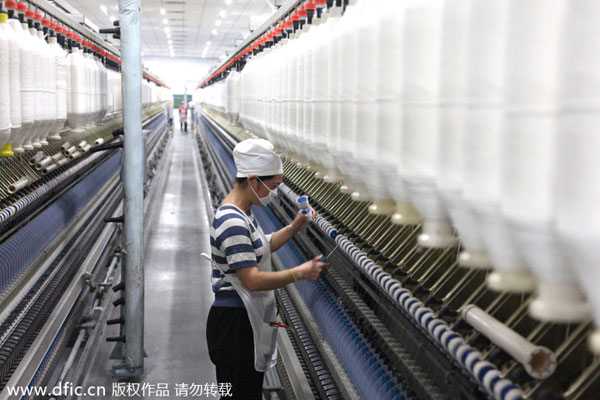
A female Chinese worker handles production of yarn at a textile plant in Xuchang city, central Chinas Henan province, Feb 10, 2014. [Photo/IC] |
Moving to the end of a difficult year for China's economy and the end of China's 12th Five-Year Plan (2011-15), three questions are on many people's minds: What is the outlook for economic growth, what has been the performance in terms of the objectives of the 12th Five-Year Plan and what does this mean for economic policy?
China's stock market volatility and the August exchange rate move scared financial markets globally. However, changes in the dynamics in the real economy in recent months have been less drastic than the financial turbulence suggests.
Nonetheless, downward pressures on growth persist as the real estate downturn continues to weigh on China's economy. Housing sales have recovered. But, amid still high inventories of unsold housing, housing construction remains in the doldrums.
The impact of the real estate downturn is particularly severe in mining and heavy industry, where it has exposed major excess capacity and weak sales growth, falling output prices and the financial strain on highly indebted companies.
Fortunately there is another side to China's economy. Robust consumption growth is an important cushion, supported by still solid wage growth. The labor market is not immune to the slowdown but the labor demand-supply situation remains favorable to employees.
The current pattern of growth has ramifications for the rest of the world, since the weakness in real estate and corporate investment has depressed imports while the strength of consumption does not support imports much, as most of the domestic consumption is produced in China.
There has been a lot of scrutiny of China's data lately. Often the criticism is ill-informed and unconvincing. However, the Oxford Economics bottom up indicator on growth in industry suggests that overall GDP growth in the first half of 2015 could possibly have been overestimated by 1 percentage point. Fortunately this does not really change the picture on growth as much as some observers have concluded.
Looking ahead, the growth outlook remains subdued, with growth likely to soften further in 2016. Thus, further macroeconomic easing is likely to follow, although we do not expect major stimulus plans. Measures are likely to continue to be focused on supporting domestic demand, while the role of fiscal policy expansion should grow.
China's five-year plans are very broad. However, the 12th had two main objectives: First, rebalancing the pattern of growth towards more consumption and services, away from the traditional emphasis on investment and industry, and second, upgrading the industrial structure.
From 2010 to 2015, China has already seen significant rebalancing of its economic structure, with a rise in the share of services from 44.2 percent of GDP in 2010 to 48.2 percent in 2014.
However, there is a catch. A major proportion of this shift has been because of heavy declines in output prices in industry, which are at least in part due to major excess capacity in heavy industry.
The price falls have made it increasingly unattractive to invest in industry. However, too many firms in heavy industry have ignored these price signals and have continued to expand capacity, often with local government involvement and support from banks. As noted, the overcapacity, price pressure and weakened profitability have become major problems, not just for these firms themselves but also for the sectors overall and the financial system.
This points to the need to speed up reforms to improve the responsiveness of companies and the financial system to price signals. Specifically, reforms are needed to harden budget constraints, improve the allocation of capital and increase the role of markets and the interest rate in the financial system, reform the governance of SOEs and level the playing field between them and other companies, raise SOE dividends, and reform the fiscal system. Also, local governments should be incentivized to stop supporting unviable loss-making local industries.
Meanwhile, there has been a promising increase in the share of consumption in GDP, although the share of investment has not come down much, which poses challenges as China's trend growth is decelerating.
More progress with raising the share of consumption in GDP calls for making more headway with reforms, particularly the ones noted above, but also reform of the rural land arrangements and the fiscal system, to support improvement in the quality of urbanization.
The author is head of Asia economics at Oxford Economics


I’ve lived in China for quite a considerable time including my graduate school years, travelled and worked in a few cities and still choose my destination taking into consideration the density of smog or PM2.5 particulate matter in the region.
Copyright 1995 - . All rights reserved. The content (including but not limited to text, photo, multimedia information, etc) published in this site belongs to China Daily Information Co (CDIC). Without written authorization from CDIC, such content shall not be republished or used in any form. Note: Browsers with 1024*768 or higher resolution are suggested for this site.
License for publishing multimedia online 0108263 Registration Number: 130349