 |
|
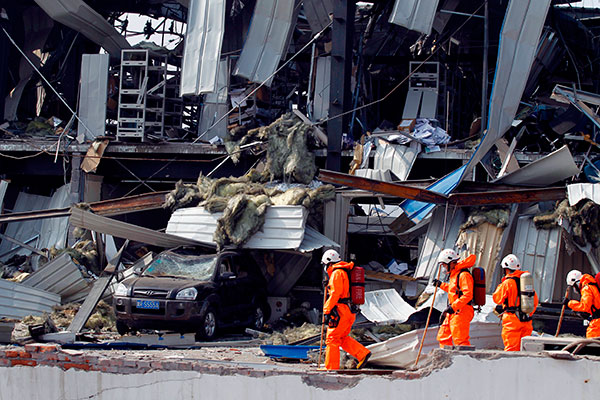
Rescuers at the Tianjin chemical explosion site. The tragic incident has reportedly demonstrated the danger China faces by not diversifying its insurance risks. [Zhu Xingxin / China Daily] |
At the Third UN World Conference on Disaster Risk Reduction in Sendai, Japan, in March, the international community was reminded that disasters hit hardest at the local level, with the potential to cause loss of life and great social and economic upheaval. Sudden onset disasters displace millions of people every year.
Over the past 20 years, disasters due to natural hazards have affected 4.4 billion people worldwide, claimed 1.3 million lives and caused $2 trillion in economic losses. These disasters not only brought death and destruction, they did so disproportionately to the poor and marginalized. Disasters have become one of the main threats to sustainable development on a global scale, yet, in many cases, they are preventable.
The International Day for Disaster Reduction, which falls on Oct 13 every year, was first celebrated in 1989. It is a day to raise awareness about the importance of disaster risk reduction and to celebrate how people and communities are reducing their exposure to disasters. It's also a day to encourage every citizen and government to take part in building more disaster-resilient communities and nations.
The global theme for 2015, "Knowledge for Life", focuses on the traditional, indigenous and local knowledge that complement modern science to strengthen resilience.
The Sendai Framework, adopted in March this year, is the first major agreement of the post-2015 development agenda, which calls explicitly for governments to employ a people-centered approach and engage directly with indigenous peoples in the design and implementation of policies, plans and standards, and to use traditional and local knowledge in disaster risk assessments.
Such knowledge is a precious national resource that can facilitate the processes of disaster prevention, preparedness and response in cost-effective, participatory and sustainable ways.
China ranks among the top 10 countries suffering from frequent, intense and unpredictable disasters, both in terms of the total number of fatalities and the economic cost.
With a long and rich experience of disasters, China has a wealth of traditional knowledge for disaster reduction which continues to contribute to environmental conservation and natural disaster management in the region. For example, in Yunnan province ethnic communities make their houses of timber and bamboo. Such houses are known to be quite stable in the face of earthquakes. Even if such houses break, they do not usually result in the loss of lives. This could be one reason why earthquakes tend to cause greater damage in modern settlements with heavier house construction than in the traditional settlements of the Dai people.
The United Nations Development Programme promotes sustainable human development to help build resilient nations and to empower people to build better lives. As the UN's development network, the UNDP has drawn on worldwide experiences for over three decades to assist China in disaster risk management, building community resilience, and information and knowledge sharing.
This year's International Day for Disaster Reduction should open eyes to how communities, united by the common threat of disasters, deploy the knowledge and insight that has been born of tradition and experience. In order to fulfill this objective, we all need to understand, acknowledge and respect indigenous knowledge as a valuable source of information and as a key contributor to reducing risk in many parts of the world. Our general efforts need to incorporate this to formulate a comprehensive and holistic approach to disaster management in China and elsewhere in the world.
The author is country director of UNDP China.


I’ve lived in China for quite a considerable time including my graduate school years, travelled and worked in a few cities and still choose my destination taking into consideration the density of smog or PM2.5 particulate matter in the region.
Copyright 1995 - . All rights reserved. The content (including but not limited to text, photo, multimedia information, etc) published in this site belongs to China Daily Information Co (CDIC). Without written authorization from CDIC, such content shall not be republished or used in any form. Note: Browsers with 1024*768 or higher resolution are suggested for this site.
License for publishing multimedia online 0108263 Registration Number: 130349