 |
|
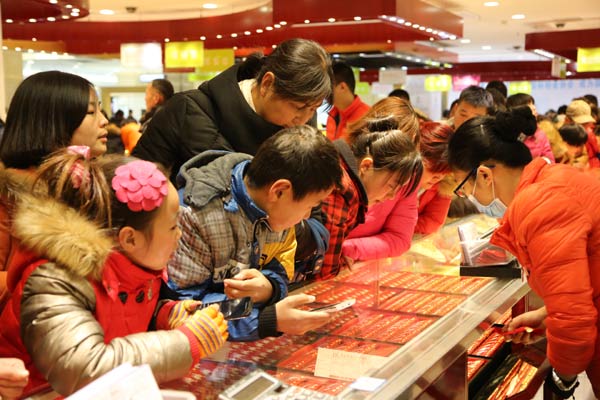
Potential buyers examine gold items at a jewelry store in Xuchang, Henan province. China's consumption growth is likely to witness a slowdown in 2015.[Provided to China Daily] |
The surge in the size of the middle class in China is an ongoing trend that everyone should be happy about.
Yet attempting to assess the actual size of this group has sparked fierce debate in the country, indicating that too many expectations of them may have prevented a consensus from being reached on how to define the middle class in China.
The latest report on global wealth by Credit Suisse is the latest fruit of the endeavor to identify this crucial group of Chinese adults who will be the key to unlocking the country's consumption potential.
The Swiss bank pointed out that, with 109 million adults this year, the Chinese middle class for the first time outnumbered the 92 million in the United States.
However, instead of acclaiming the news that China's middle class is now the world's largest, domestic opinion has dwelled on how unrealistic it is to try and live a "middle-class" lifestyle on the suggested wealth floor of $50,000 a year (in purchasing power parity) in today's China, particularly in big Chinese cities such as Beijing and Shanghai.
Yet after more than three decades of double-digit growth, tens of millions of Chinese people, if not more, are able to live comfortable lives in a moderately well-off Chinese society. The expansion of the number of middle-income and rich Chinese from almost zero to be the largest in the world is largely in line with the spectacular rise of the Chinese economy during the period when several hundreds of millions were lifted out of poverty.
Given the middle class generally acts as an agent of stability and prosperity, it is natural for both Chinese policymakers and the international community to pin high hopes on its much-expected growth in China.
Domestically, the changing consumption patterns typically associated with the middle class will give a huge boost to China's uphill struggle to build domestic consumption into a powerful engine for sustained growth of the economy.
And internationally, more and more countries will benefit from the increasingly stronger purchasing power of Chinese middle-class tourists, as they displayed in Japan during the week long National Day holiday early this month. More than 4 million Chinese tourists are expected to visit Japan this year, up more than 60 percent over 2014. And that accounts for less than 5 percent of the total of Chinese people who will take tourist trips this year.
Yet, Chinese people have generally cast a suspicious look at the report that ranked China the largest middle-class country in terms of number, even though many of them may actually possess more wealth than the minimum amount that the Swiss bank deemed necessary to define the middle class.
Two reasons may explain their reluctance to accept the latest assessment.
One is their propensity to take into account current financial burdens and anxieties about future expenditures when gauging their actual wealth. If they cannot live in a comfortable and confident way, Chinese people usually will not regard themselves as a member of the middle class.
The other may be about the uneven distribution of wealth. Nearly 1 percent of the world's population holds about 50 percent of the total private wealth, the global wealth report noted. China's wealth disparity has also served to skew people's perceptions about their positions on the social ladder.
If these concerns cannot be properly addressed, Chinese people will hesitate to fully demonstrate their consumption strength even when they become richer. In a sense, their counterintuitive suspicion about their rising status in the world represents a call for changes that the middle class demand.
The author is a senior writer with China Daily zhuqiwen@chinadaily.com.cn


I’ve lived in China for quite a considerable time including my graduate school years, travelled and worked in a few cities and still choose my destination taking into consideration the density of smog or PM2.5 particulate matter in the region.
Copyright 1995 - . All rights reserved. The content (including but not limited to text, photo, multimedia information, etc) published in this site belongs to China Daily Information Co (CDIC). Without written authorization from CDIC, such content shall not be republished or used in any form. Note: Browsers with 1024*768 or higher resolution are suggested for this site.
License for publishing multimedia online 0108263 Registration Number: 130349