 |
|
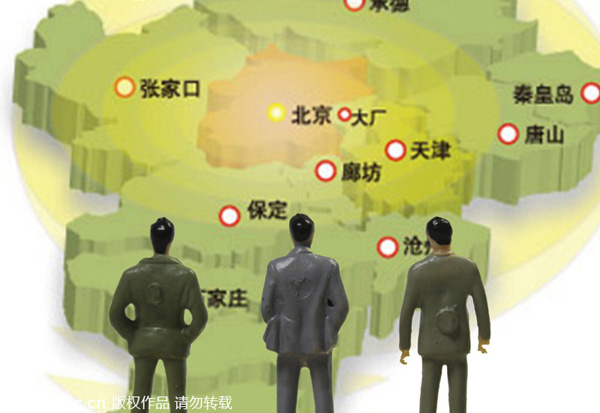
View of Beijing,Tianjin and Hebei province in map. April 14, 2014. [Photo/IC] |
To get a better understanding of the grand project to integrate development of Beijing and neighboring Tianjin Municipality and Hebei province, one has to start with the country's ongoing transformation of the regional development pattern in which "competition" used to play integral dominant role.

In this development model, the central government delegates powers to the local governments and links their interests, which range from tax revenues to personal promotion, to regional development. This motivates them to play a major role in boosting the local economies and enhancing the country's economic competence.
However, this has produced some fierce, even cut-throat competition, between governments at all levels, as they compete with each other rather than cooperate. While this competition has benefited some regions in regards to their economic achievements, it has also led to local protectionism, market divisions and administrative barriers.
With the Chinese economy entering a new normal and economic growth beginning to slow down, a change has to be made to enhance the synergy between different areas before the unhealthy competition leads them astray. And that is exactly what the Beijing-Tianjin-Hebei integration is designed to achieve.
However, this is not the first time that the major trilateral project has been in the spotlight. An economic coordination zone covering Beijing and Tianjin was founded early in 1981, 14 years before the country proposed the Bohai Sea Rim Strategy in its Ninth Five-Year Plan (1996-2000). The Central Economic Working Conference last year officially made Beijing-Tianjin-Hebei integration a national strategy for regional development, with the other two being the Belt and Road Initiative and the Yangtze River Economic Belt.
Yet despite its significant role in numerous government documents and study reports, the project has in fact achieved little progress, because the three areas are still bent on competing with one another to attract investments, projects, and business opportunities. Such a zero-sum mentality will, unsurprisingly, make it difficult for them to cooperate for win-win cooperation.
Besides, the unbridgeable gap between Beijing, Tianjin, and Hebei provinces with regards to their administrative rankings, has failed to incubate fair negotiations in the government-driven competition, not to mention the lack of smooth exchanges of resources among them. The barriers set up to protect local interests have also stalled the implementation of the central government's development policies.
Unlike the East China's Yangtze River Delta and Southeast China's Pearl River Delta, the Beijing-Tianjin-Hebei region has struggled to push ahead with its integration, giving rise to a slew of problems such as the capital's traffic congestion and lingering smog. The time has come for the three neighbors to adopt a synergy-oriented approach for shared prosperity.
Setbacks aside, it should also be noted that the integration is speeding up after President Xi Jinping elaborated on the significance and key missions of the national strategy, and last year the State Council set up a team headed by Vice-Premier Zhang Gaoli to promote the regional integration. In 2014, more than 60 major projects in the fields of transportation and ecological environmental protection all achieved their goals as expected, and the 113 or so this year are advancing at full speed.
In contrast, institutional reform has lagged behind, as local governments still play a decisive role in implementing relevant policies, not the market. More importantly, to handle the interest-based conflicts that involve the central government, local governments, enterprises, social organizations, and individuals, all departments concerned should resort less to administrative measures and uphold the rule of law to allow a multitude of players to negotiate when they are in dispute.
The author is a researcher at the Development Research Center of the State Council.


I’ve lived in China for quite a considerable time including my graduate school years, travelled and worked in a few cities and still choose my destination taking into consideration the density of smog or PM2.5 particulate matter in the region.
Copyright 1995 - . All rights reserved. The content (including but not limited to text, photo, multimedia information, etc) published in this site belongs to China Daily Information Co (CDIC). Without written authorization from CDIC, such content shall not be republished or used in any form. Note: Browsers with 1024*768 or higher resolution are suggested for this site.
License for publishing multimedia online 0108263 Registration Number: 130349