 |
|
Zhao Guopin / For China Daily |

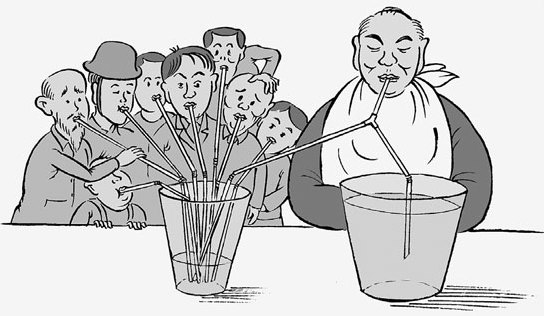
The 12th Five-Year Plan (2011-15) period has seen great improvements being made in the income distribution system. In February 2013, the authorities decided to further improve the income distribution system, increase urban and rural residents' incomes, narrow the income gap and manage income distribution according to the Guideline on Deepening Reform of Income Distribution System, which spelt out the overall demand and target of the income distribution system reform during the 12th Five-Year Plan period.
The Amendment to the Criminal Law (VIII) in February 2011 made the refusal to pay workers' dues a crime in order to deter intentional default on paying wages. To narrow the increasing income gap, the Amendment to the Individual Income Tax Law was approved in June 2011, which increased the threshold of individual income tax to 3,500 yuan ($550.1) and changed the 9-level excess progressive tax rate to 7 levels, reducing the tax burden of the middle- and low-income groups and increasing their disposable incomes.
In August 2014, the authorities launched the salary system reform for senior central government enterprise officials by placing caps on their salaries and establishing a differentiated salary distribution system. The authorities have also promoted performance-based payments in many public organizations, including compulsory education schools and health centers such as hospitals. And in January 2015, the authorities decided to establish rank promotion besides administrative promotion channels for grassroots civil servants.
The goal of income distribution reform during the 12th Five-Year Plan is to increase people's incomes. To ensure that, the government should first improve farmers' subsidy and improve the interest compensation mechanism in major grain-growing areas.
Second, it should raise the minimum wage level in order to increase the low-income group's incomes.
Third, the government has to change the basic pension system. China has increased enterprise retirees' basic pension for 11 consecutive years from 700 yuan a month in 2004 to 2,082 yuan in 2015.
Fourth, the government should change the mechanism of social assistance and security standard to further increase the subsidy given to low-income and disadvantaged groups.
And fifth, it has to change its yardstick to measure poverty. A positive move in this direction was the lifting of the benchmark for rural poverty to 2,300 yuan in 2011, up 92 percent over the 2009 level.
The income distribution reform, too, has made good progress. For instance, Chinese people's income levels have increased remarkably. In 2014, the per capita disposable income of urban residents in China was 28,843 yuan, 50.94 percent higher than in 2010. And the per capita income of rural residents was 10,488 yuan, up 77.21 percent over the 2010 level.
More importantly, the income gap between urban and rural residents has reduced remarkably - from 3.23 times in 2010 to 2.75 times in 2014.
Also, the income distribution pattern has improved. In 2010, residents' incomes accounted for 46.91 percent of China's GDP. In 2014, the percentage increased to 48.
But there is still a lot of work to do to further deepen the income distribution reform, especially during the 13th Five-Year Plan (2016-20) period. The 13th Five-Year Plan period is the key stage in the building of an all-round moderately well-off society. And the key task of the income distribution reform in this stage is to increase people's incomes to achieve the goal of doubling rural and urban residents' real income by 2020, compared with that of 2010.
It is therefore necessary to expedite the process for legislation on income distribution, for a law is needed to build a new and mature income distribution system that suits the need of a socialist market economy.
The author is a researcher at the Institute for Labor and Wage Studies, affiliated to the Ministry of Human Resources and Social Security.


I’ve lived in China for quite a considerable time including my graduate school years, travelled and worked in a few cities and still choose my destination taking into consideration the density of smog or PM2.5 particulate matter in the region.
Copyright 1995 - . All rights reserved. The content (including but not limited to text, photo, multimedia information, etc) published in this site belongs to China Daily Information Co (CDIC). Without written authorization from CDIC, such content shall not be republished or used in any form. Note: Browsers with 1024*768 or higher resolution are suggested for this site.
License for publishing multimedia online 0108263 Registration Number: 130349