 |
|
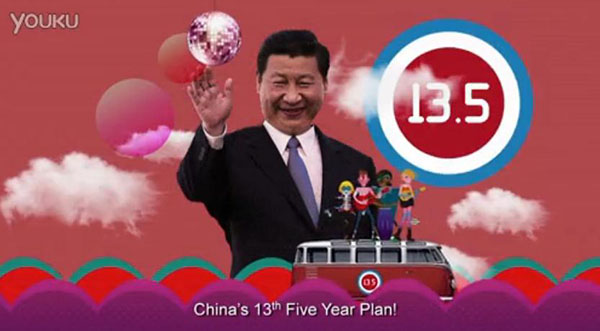
Screenshot from the video Song of Shisanwu. [Photo/Agencies] |
The just-concluded Fifth Plenum of the 18th Communist Party of China Central Committee has drawn up a roadmap for the realization of a moderately well-off society in an all-round way in the coming five years. To make this plan a reality, China needs to choose an appropriate economic growth path based on the economic trends resulting from its economic transformation, so that a solid foundation can be laid for its sustainable development and the realization of the goal by 2020.
To achieve this by the end of the 13th Five - Year Plan (2016-20) period, China needs an annual economic growth rate of about 6.5 percent during the five years. But changes in the country's economic growth trend, structure and driving force will ensure such a moderate economic growth rate is attainable.
The country's accelerated transformation from a production-dominated manufacturing economy to one driven by services and "Internet-plus" manufacturing will create competitive advantages. Its ongoing urbanization, facilitated by the reform of the hukou or household registration system that divides rural and urban residences, and efforts to promote upgrading of its consumption structure are expected to lubricate the country's much-anticipated transformation from the consumption of mostly visible commodities to the consumption of mostly invisible commodities. The expected growth of services-led consumption by the end of 2020 will sharply increase the added value of services and boost the role of consumption in national economic growth.
New progress in China's ongoing efforts to realize economic structural adjustment is expected to increase the contribution of services from 51.4 percent of GDP in the first three quarters of this year to more than 55 percent by 2020. The growth in domestic consumption will build up a lasting driving force for the country's economic growth. The effort to raise the proportion of the service sector in the country's foreign trade, which is expected to rise from 12.3 percent last year to 20 percent in 2020, will help sharpen China's competitive edges in regional and global trade.
At the same time, intensified efforts to deepen economic and administrative reforms are expected to help ease the pressures on the economy and lay an important foundation for 6 to 7 percent growth in the middle and long run.
To release new vitality for its economic growth, the country should open up its service market wider to follow the general development trend of the sector. A fully opened service market will attract more capital investment from nongovernment sources, boost the country's service trade and form a full-fledged services-dominated economic structure.
To this end, the country should first break the 50 percent monopoly that exists in this sector and increase the sector's opening-up and quality, while also reducing prices. The dismantling of the administrative or market monopoly in the service sector will facilitate its marketized reforms, absorb more nongovernmental capital and activate its latent market vigor.
At the same time, the country should also push for the opening-up of the service market through expanded public services, so as to give the market and nongovernment players a bigger role in the supply of public services.
Considering the series of structural contradictions and challenges the country now faces in its push for industrial transformation led by the service sector, it also needs to accelerate structural reforms in the investment, financial, fiscal, taxation and educational realms to eliminate the existing obstacles.
For example, necessary reforms should be launched to change the status quo whereby nongovernmental capital represents a very low proportion of the funds for the provision of educational, health, and cultural services. Moreover, reforms in taxation could give more emphasis to taxes in the consumption sector. Financial reforms would provide small and medium-sized businesses easier access to capital input.
Without removing the obstacles that lie in the way of the entry of non-governmental capital to these areas, it will be difficult for the country to form a services-dominated industrial structure.
The author is president of the China Institute for Reform and Development based in Hainan province, South China.


I’ve lived in China for quite a considerable time including my graduate school years, travelled and worked in a few cities and still choose my destination taking into consideration the density of smog or PM2.5 particulate matter in the region.
Copyright 1995 - . All rights reserved. The content (including but not limited to text, photo, multimedia information, etc) published in this site belongs to China Daily Information Co (CDIC). Without written authorization from CDIC, such content shall not be republished or used in any form. Note: Browsers with 1024*768 or higher resolution are suggested for this site.
License for publishing multimedia online 0108263 Registration Number: 130349