 |
|
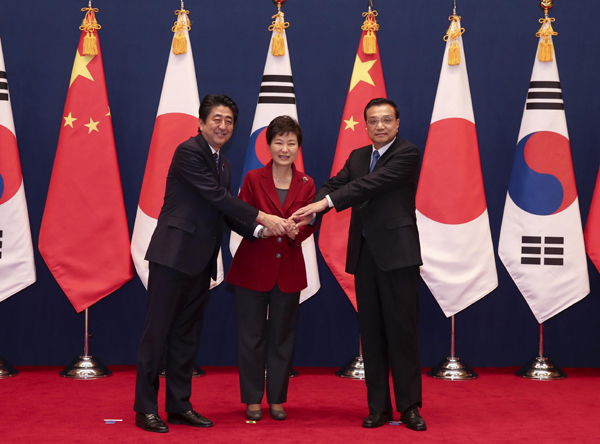
Chinese Premier Li Keqiang (right), Japanese Prime Minister Shinzo Abe (left) and South Korean President Park Geun-hye (center) shake hands during the sixth China-Japan-ROK trilateral meeting in Seoul, Nov 1, 2015. [Photo/Xinhua] |
After a three-year hiatus, the 6th China-Japan-Republic of Korea summit was held in Seoul on Sunday. Chinese Premier Li Keqiang attended the summit on the sidelines of his visit to the ROK from Saturday to Monday, which included talks with Japanese Prime Minister Shinzo Abe and ROK President Park Geun-hye.
The summit was not held during the past three years, which could have been used to deepen trilateral cooperation. One of the reasons for that was the tensions in East China Sea over maritime territorial disputes, which escalated in 2012. Just a year after he assumed office in 2012, Abe paid a visit to the Yasukuni Shrine, which among others honors 14 Class-A war criminals, dealing a blow to Japan's relationship with China and the ROK both.
That proved pragmatic trilateral cooperation has a lot to do with their political ties, in which problems left over by history play a fundamental role. In other words, historical issues can neither be avoided nor ignored by any of the three countries.
But despite that, the three sides have always had access to cooperative channels to continue their political discussions. For Beijing and Tokyo, the joint statement on the normalization of their diplomatic ties in 1972, the China-Japan Treaty of Peace and Friendship in 1978 and the China-Japan Joint Declaration in 1998 make it clear that correct understanding the history is at the base of bilateral ties. A joint statement inked in 2008 reiterates key principles of the three documents, with focus on advancing strategic and mutually beneficial relations.
Tensions between Japan and its two neighbors began to ease since last November, suggesting that the resumption of trilateral meeting was possible. But the three countries have to thoroughly reflect on the three-year-long deadlock, and convince their people and the international community of their shared willingness to cooperate. This is all the important given the speed bumps on the road to improving China-Japan and ROK-Japan relations.
The prospect of regional coordination, too, has facilitated the reopening of the China-Japan-ROK summit. As its economy enters a "new normal", China is making notable progress in implementing some of its major cooperative proposals, including the Silk Road Economic Belt and the 21st Century Maritime Silk Road, as well as the Asian Infrastructure Investment Bank.
The China-ROK Free Trade Agreement signed earlier this year will further enhance trade, finance and investment cooperation between the two sides. Moreover, after having promulgated the "three arrows" strategy of a hyper-easy monetary policy, muscling two controversial security bills through Japan's parliament, and reaching a preliminary agreement on the Trans-Pacific Partnership Agreement with 11 other members, the Abe administration is likely to shift its focus to the economy, people's well-being and social welfare.
All the same, the three countries have to deepen their cooperation on nontraditional projects, such as sharing information on nuclear pollution, especially after the Fukushima nuclear crisis in Japan in 2011. And on regional security, they should play a bigger role to establish a communication mechanism that covers the whole of the Asia-Pacific region.
Accounting for 70 percent of Asia's economic aggregate, China, Japan and the ROK can present an example of a highly fruitful regional cooperation if they manage to instill inclusiveness and openness in their trilateral relationship. They should also seek dialogue, as opposed to confrontation, to defuse geopolitical disparities and shoulder their due responsibilities of safeguarding regional and global stability.
The author is deputy director of the Institute of Japanese Studies at the Chinese Academy of Social Sciences.


I’ve lived in China for quite a considerable time including my graduate school years, travelled and worked in a few cities and still choose my destination taking into consideration the density of smog or PM2.5 particulate matter in the region.
Copyright 1995 - . All rights reserved. The content (including but not limited to text, photo, multimedia information, etc) published in this site belongs to China Daily Information Co (CDIC). Without written authorization from CDIC, such content shall not be republished or used in any form. Note: Browsers with 1024*768 or higher resolution are suggested for this site.
License for publishing multimedia online 0108263 Registration Number: 130349