 |
|
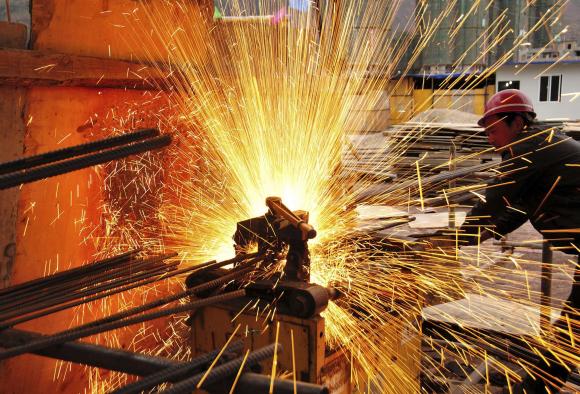
A worker welds at a construction site in Yiliang, Yunnan province, February 28, 2015.[Photo/Agencies] |
At the recently concluded Fifth Plenum of the 18th Communist Party of China Central Committee, the “Four Comprehensives” became the grand blueprint for the 13th Five-Year Plan (2016-20). Each of the four tasks requires broad measures and pragmatic actions.
The first one — and the most critical— stresses the task of building a “moderately prosperous society”. It does not refer to “middle class”, a term that is often, but mistakenly, evoked in the international media. True, the middle class is emerging in China, but it is still not comparable to that in the West.
In the United States and the European Union, the average per capita GDP, adjusted to purchasing power parity, varies between $55,000 and $38,000, but in China it is still $13,200. As a result, the term has vastly different meanings in advanced economies and China.
Unlike in the West, higher living standards in China are a recent development. Chinese families enjoy very little of the kind of accumulated wealth that is taken for granted in the West. China is now building social security and welfare systems that advanced economies have had for generations. And it will take another five years for the country to lift out of poverty most of the remaining 70 million people.
A moderately prosperous society means rapidly rising per capita incomes. It also means basic social security and less environmental degradation. It is the Four Comprehensives’ strategic goal, while the other three represent major strategic measures that are required to realize this objective.
The second task is to “deepen reform”. In China, the Deng Xiaoping era unleashed reforms that were designed to industrialize the mainland in record time. Seeking to surpass the so-called “middle-income trap”, President Xi Jinping’s reforms face even more challenging obstacles and entrenched interests.
The structural reforms must ensure the completion of industrialization in the poorer provinces and regions even as they seek to transform China into a post-industrial society in which services rather than manufacturing fuel growth.
Here’s the caveat: success will be possible only through “structural reforms”. Since this means reducing the government’s role by increasing market power, it will require the reform of state-owned enterprises and thus a great balancing act between economic restructuring and new job creation.
The third task is the “rule of law”. Along with other Chinese reformers, Xi is very cognizant of the fact that, without the rule of law, the middle-income trap and disharmony could become real risks. This is why the top leadership’s anti-corruption campaign is so critical to drastically reduce corrosive corruption; the latter undermines the trust and social capital required in a post-industrial society.
The fourth comprehensive is “strict discipline in the Party”, which means transforming the CPC. This is something that remains underestimated in the West. Indeed, the newly-revised CPC rules on disciplinary penalties, which separate Party discipline from the law, mark a progress in advancing the rule of law. In order to be accountable to the people, the Party is expected to lead by example.
When Deng Xiaoping began his reforms, the idea of gradual change was seen as a mistake in the West, where most multilateral financial organizations said China’s development would fail. But the Chinese experiment succeeded while others failed.
Today, too, China’s new grand plan has met with great skepticism in the West. So once again, Beijing will act on its own and “seek truth from the facts” — not from ideological doctrines.
If China’s growth continues to be around 6.5 percent, which is the evolving target, the country’s per capita income will rise to $21,000 — close to that of Mexico and Turkey — in five years.
While critics say this is impossible because China’s growth is slowing, they are missing the point. It is precisely the rebalancing of the economy from investment and net exports to consumption and innovation that requires the deceleration of China’s growth so that Chinese people’s living standards can be doubled by 2020.
That’s the way to sustain the Chinese Dream.
The author is research director of international business at the India China and America Institute (US) and a visiting fellow at the Shanghai Institutes for International Studies (China) and the EU Centre (Singapore).


I’ve lived in China for quite a considerable time including my graduate school years, travelled and worked in a few cities and still choose my destination taking into consideration the density of smog or PM2.5 particulate matter in the region.
Copyright 1995 - . All rights reserved. The content (including but not limited to text, photo, multimedia information, etc) published in this site belongs to China Daily Information Co (CDIC). Without written authorization from CDIC, such content shall not be republished or used in any form. Note: Browsers with 1024*768 or higher resolution are suggested for this site.
License for publishing multimedia online 0108263 Registration Number: 130349