 |
|
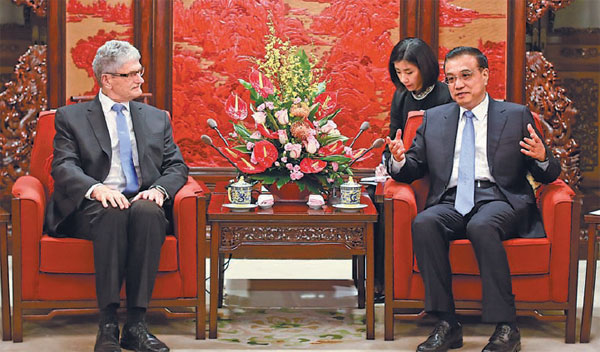
Premier Li Keqiang meets with Mogens Lykketoft, president of the 70th session of the United Nations General Assembly, on Tuesday in Beijing. Li said China wants to push forward a comprehensive climate change agreement in Paris in December. [Photo/China Daily] |
Six years ago, I was covering the unsuccessful United Nations climate summit held in Copenhagen, and I saw first-hand how China's image was tarnished, even though it had been making continual efforts to help achieve a global deal.
As countries have been drumming up their efforts to reach a deal on reducing greenhouse gas emissions in Paris in a few weeks, it is meaningful to take stock of how much better China has prepared itself in the years between the two sets of talks.
In my view, the past six years have seen China develop growing green awareness, improved institutional arrangements, better low-carbon commitments and active participation in cooperation with other countries. With such dramatic changes, China will be in a better position to help promote an agreement in Paris.
Since the late 1970s, when China launched its reform and opening-up policy, until recently, the country's overarching strategy has been "development is the unyielding principle", which resulted in decades-long fast economic growth, but at the cost of severe environmental pollution and wasteful energy consumption.
Since the change in leadership in 2012, the move away from this strategy has been accelerated.
The leadership has been promoting the understanding that ecological civilization and building a beautiful China are an important part of realizing the Chinese dream of the rejuvenation of the Chinese nation. This has started to guide China's economic activities, and been embodied in the concept of the economic new normal.
To turn concepts into actions, China has been beefing up its efforts to build a legal framework to strengthen its environmental protection. For example, leading officials at various levels are required to accept environment and natural resources auditing when they leave their positions.
And after laws related to fighting air and water pollution and realizing a circular economy, China's law-making body is also busy drafting a law on climate change prevention, which should be another milestone in the country's environmental protection. But what is most encouraging is China has pledged to realize a peak in its carbon emissions by 2030 by improving energy efficiency and increasing the ratio of renewable energy in its total energy mix, which is targeted at 15 percent by 2020 and 20 percent by 2030.
It has also made a pledge to lower carbon emissions per unit of GDP by 60 to 65 percent from the 2005 level by 2030.
In its bid to turn greener, China has also quickened the pace of trying to usher in a nationwide cap-and-trade emission system by 2017, and a carbon emission trade system is being piloted in some regions at present.
And surprisingly, China, which has mainly been powered by coal for years, saw its consumption of coal decline last year for the first time mainly as a result of better energy efficiency and economic restructuring.
Along with these domestic actions, China has spared no effort on the bilateral and international levels as well. Since last year, President Xi Jinping and his US counterpart Barack Obama have twice made presidential announcements about injecting inputs aimed at making Paris a success. China and the European Union announced joint commitments and actions in June as well.
Meanwhile, China has been pledging and taking increased actions in South-South cooperation by embedding more sustainability content, and it has been busy coordinating with the BRICS countries (Brazil, Russia, India, China and South Africa), who share similar stances on climate change.
All in all, China has taken climate actions as a trigger to institutional and legal framework improvement, development pattern transformation, lifestyle changes and also a chance to showcase its rising desire to be a responsible global stakeholder.
Being so well prepared, China, together with other players, should be able to make it the bottom line that Paris proves more fruitful than Copenhagen.
The author is China Daily chief correspondent in Brussels. fujing@chinadaily.com.cn


I’ve lived in China for quite a considerable time including my graduate school years, travelled and worked in a few cities and still choose my destination taking into consideration the density of smog or PM2.5 particulate matter in the region.
Copyright 1995 - . All rights reserved. The content (including but not limited to text, photo, multimedia information, etc) published in this site belongs to China Daily Information Co (CDIC). Without written authorization from CDIC, such content shall not be republished or used in any form. Note: Browsers with 1024*768 or higher resolution are suggested for this site.
License for publishing multimedia online 0108263 Registration Number: 130349