 |
| Cai Meng/China Daily |
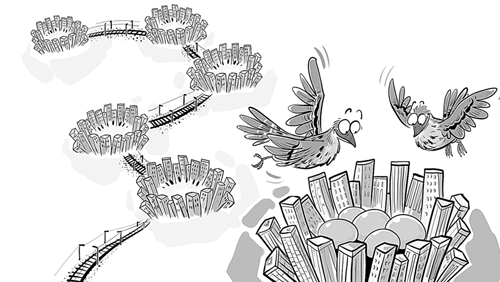
The construction of high-speed railway is accompanied by the building of new satellite cities around China. Most of these satellite cities, with high-speed railway stations as their center, are far from the existing urban areas. Incomplete data show more than 70 such satellite cities are under construction, or have already been approved, as part of China's urbanization drive. If the smaller towns are taken into account, their number will be higher.
The problem is, these construction projects will increase local governments' debts and worsen their financial situation. Besides, many newly built satellite cities are sparsely populated.
Local governments assume high-speed railway can change the existing regional economic patterns of cities, bring new economic benefits, and facilitate the rapid development of the new city areas. The fact is, local governments obtain huge areas of land to continue deriving benefits from "land finance", that is, secure large amounts of revenue from selling land to real estate developers again after the old urban land areas are almost sold out.
But will the new satellite cities along the high-speed railway become new growth points for local economies or turn into development traps? That a large number of cities believe they will become new growth points speaks volumes of the potential risks behind the new urban boom.
For metropolises, the new satellite cities can accommodate more people and thus form new clusters of industries, commerce and logistics, and become new economic growth points. But for small and medium-sized cities, especially in central and western China, blindly joining the rush to build new satellite cities will do more harm than good, because smaller cities have limited resources, populations, simpler industrial structures, weaker research and development capacities, and smaller government budgets.
Take the Shinkansen high-speed railway project in Japan as an example. Some of its stations are far from urban areas, because the aim of the project was to boost local economic development, especially in the Kansai region. But because of the poor supporting facilities, the expected increase in passenger flow in the region did not materialize. Limited tax revenues of local governments mean they don't have enough money to properly develop the areas around the new railway stations.
As a result, enterprises and workers in Kansai gradually moved to areas around Tokyo. Drawing a lesson from Japan's experience, small and medium-sized cities in China should think twice before making the important decision of building new satellite cities.
High-speed railway, despite its convenience and advantages, does not always bring expected benefits. Economic and production resources are more inclined to flow from small to big cities, not the other way round. Benjamin Faber, an economist with the University of California, Berkeley, has conducted research on the influence of China's high-speed road network on small cities along the routes from 1997 to 2006. He found the average economic growth of small cities near highways was 18 percentage points lower, and average industrial output growth 26 percentage points lower than those of other small cities.
High-speed railway can magnify a place's developmental advantage, as well as its disadvantage, while draining small cities' funds. Therefore, the authorities of small cities should first find ways to attract enough people to the existing new satellite cities, because before building new ones, China already has empty cities and the country's aging population will reach its peak in several years.
The article was firstly published on China Youth Daily on Nov 25.


I’ve lived in China for quite a considerable time including my graduate school years, travelled and worked in a few cities and still choose my destination taking into consideration the density of smog or PM2.5 particulate matter in the region.
Copyright 1995 - . All rights reserved. The content (including but not limited to text, photo, multimedia information, etc) published in this site belongs to China Daily Information Co (CDIC). Without written authorization from CDIC, such content shall not be republished or used in any form. Note: Browsers with 1024*768 or higher resolution are suggested for this site.
License for publishing multimedia online 0108263 Registration Number: 130349