 |
|
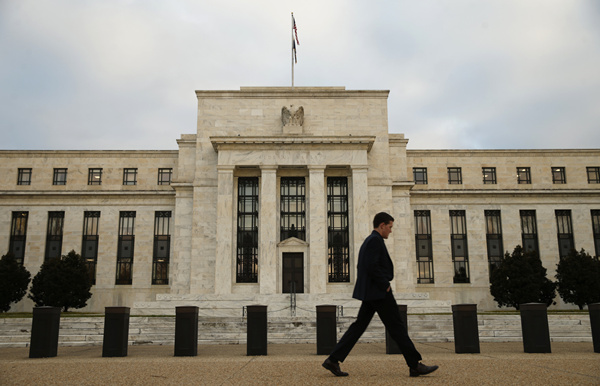
A man walks past the Federal Reserve in Washington, December 16, 2015. The U.S. central bank is widely expected on Wednesday to hike its key federal funds rate by a modest 0.25 percent. It would be the first tightening in more than nine years and a big step on the tricky path of returning monetary policy to a more normal footing after aggressive bond-buying and near-zero borrowing costs. [Photo/Agencies] |
The first rise in US interest rates in almost a decade has been long overdue. After leading the world economy into seven years of super cheap money, it is urgent that the world's largest economy assume its duty to blaze a trail out of the dangerous lifestyle of zero interest rates.
The lost two decades of the Japanese economy, once the world's second largest, have only proved the ineffectiveness of excessively loose monetary policies in tackling fundamental structural problems. If the United States can manage to maintain robust growth with normalized interest rates in the coming years, it will give a huge boost to the confidence of policymakers in many other countries who have also resorted to cheap money as economic painkillers.
But if the US economy fails to cope with a gradual rise in its interest rates strongly enough, other countries may need to not only prepare for increasing uncertainties but also rethink the cost of cheap money.
Rising indebtedness, depressed energy prices and sluggish global growth have made 2015 a year of great anxieties. After the International Monetary Fund cut its global growth forecast to 3.1 percent this year, the United Nations last week also cut its forecast for global economic growth in 2015 to 2.4 percent, largely due to lower commodity prices, increased market volatility and slow growth in emerging market economies.
But the most uncertain of all is where the hike in US interest rates will take not only its own economy but also the global financial and commodities markets.
Some argue that, as a result of the divergence of US monetary policy and that of other economies with zero interest rates, a strong US dollar may hurt US exports and slow its overall economic growth.
Others worry that a rise in US interests may exert extra pressure on the prices of global commodities and expedite outflows of capital from developing countries, undermining their economic growth.
These are all justified concerns.
If the US exports shrink too much, slowing its economic growth and increasing unemployment, the US Fed will find it very difficult to continue to raise interest rates step by step to a normal level. If capital outflows accelerate to trigger debt crises in emerging economies, whose build-up of corporate debt doubled between 2008 and 2014, or oil and commodities prices further plunge to cause fiscal troubles in related countries, international criticism of the US monetary policy will become very loud.
But these problems are a result of deep-rooted structural problems rather than a consequence of a normal level of borrowing costs which is essential to a sustainable balance between demand and supply.
Just like low-priced coal or oil that fuels energy-intensive economic growth in the short term but causes serious environmental damage in the long run, cheap money helps allay immediate economic headaches but postpones the painful economic restructuring necessary for sustainable growth.
The UN climate change conference in Paris has displayed a consensus for action among the international community to end the addiction to cheap fossil energy. But countries have yet to agree on the real risk of accepting cheap money as a lifestyle.
China's recent decision not to cut domestic gasoline prices in line with falling international oil prices is an unpopular but bold step to reduce its reliance on cheap fossil energy even though its economic growth is slowing.
It is hoped that the belated hike in US interest rates will set a needed example for policymakers around the world to refuse cheaply borrowed growth as the easy answer to long-term economic challenges they face.
The writer is a senior writer with China Daily.
zhuqiwen@chinadaily.com.cn


I’ve lived in China for quite a considerable time including my graduate school years, travelled and worked in a few cities and still choose my destination taking into consideration the density of smog or PM2.5 particulate matter in the region.
Copyright 1995 - . All rights reserved. The content (including but not limited to text, photo, multimedia information, etc) published in this site belongs to China Daily Information Co (CDIC). Without written authorization from CDIC, such content shall not be republished or used in any form. Note: Browsers with 1024*768 or higher resolution are suggested for this site.
License for publishing multimedia online 0108263 Registration Number: 130349