 |
|
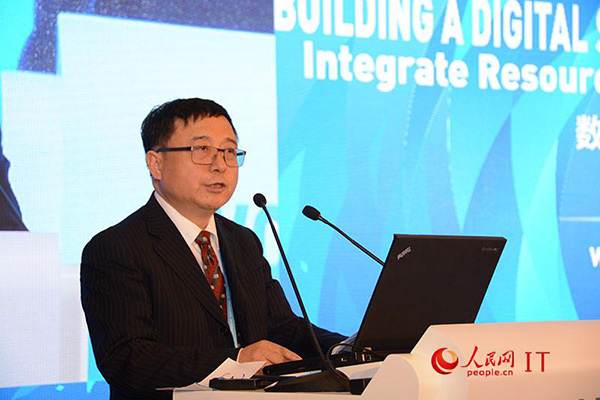
Wu Shizhong, Party Secretary of China Information Technology Security Evaluation Center, at a sub forum on digital silk road during the second World Internet Conference in Wuzhen, East China's Zhejiang province, Dec 16, 2015. [Photo/people.cn] |
The Silk Road Economic Belt and the 21st Century Maritime Silk Road, together known as the Belt and Road Initiative, are aimed at building an inclusive community of shared interests and political mutual trust, and integrating developed and developing economies. They will not only help more Chinese enterprises to "go global" but also benefit many Middle East states.
But the implementation will not be easy in the face of the multiple security threats: violence, and political and social unrest that still straddle the routes and bridgeheads between Africa, Asia and Europe. Most regional players are undergoing (or may soon undergo) social transition, which, along with the escalating tensions in the neighborhood, add to the uncertainties. But the more daunting task is to eliminate terrorists and extremists, especially the bloodthirsty Islamic State jihadists.
The continuing clashes between Israelis and Palestinians, despite being relegated to the background owing to the IS' atrocities, remain a ticking time bomb in the region. So is the complex Kurdish problem that has haunted many Middle East countries, particularly Turkey whose ruling Justice and Development Party ended a two-and-a-half-year peace process in July by renewing its attack on the outlawed Kurdistan Workers' Party.
Despite the mess it is in, the oil-rich Middle East is home to almost 400 million people across 15 million square kilometers. And the regional states have great potential to deepen their economic cooperation with China, especially because their economies are complementary to China's.
In the pursuit of sustainable development, China is trying to replace some of its high energy-consuming low-end industries with environment-friendly and high-tech ones. This industrial shift by China offers Middle East countries many opportunities, which they should not miss if they want to upgrade their industrial structures for sustainable growth.
They could, for example, seek to expand their trade, and deepen their energy and financial cooperation with China, which can range from exploitation and refining of oil to increasing employment. China, on its part, needs to enhance its political and financial capabilities to not only realize the Belt and Road Initiative, but also improve its people's well-being.
China is still a developing country with a number of underdeveloped regions. Its per capita GDP was just over $7,500 last year, much less than in advanced economies and some major oil exporters in the Middle East. Going by the World Bank's poverty line of $1.9 a day, China still has about 200 million impoverished people, that is, one out of every six or seven Chinese lives in poverty.
Maximizing the economic synergies between China and the rest of the world, therefore, should be the priority of the Chinese government. The Beijing-led Asian Infrastructure Investment Bank with an initial authorized capital of $100 billion aims at financing infrastructure construction projects along the Belt and Road and can help boost the Middle East economies.
But the AIIB should be prepared to face mountainous problems because of the years, money and other resources the West has squandered waging fruitless wars in the Middle East since the end of the Cold War and turned the region into a tinderbox. The US alone has spent an estimated $1.7 trillion - more than Sudan's total GDP for the past decade - to continue its military interventions in the Middle East in just 15 years.
Such an astronomical amount could have been used to defuse tensions in the Middle East, boost regional growth and reduce poverty, instead of creating chaos. It is time the major powers stopped interfering and intervening in Middle East affairs and, instead, helped the regional players to restore peace and stability.
The author is a professor of Middle East Studies at the Chinese Academy of Social Sciences and a member of a think tank affiliated to the Institute of Middle East Studies, Shanghai International Studies University.


I’ve lived in China for quite a considerable time including my graduate school years, travelled and worked in a few cities and still choose my destination taking into consideration the density of smog or PM2.5 particulate matter in the region.
Copyright 1995 - . All rights reserved. The content (including but not limited to text, photo, multimedia information, etc) published in this site belongs to China Daily Information Co (CDIC). Without written authorization from CDIC, such content shall not be republished or used in any form. Note: Browsers with 1024*768 or higher resolution are suggested for this site.
License for publishing multimedia online 0108263 Registration Number: 130349