 |
|
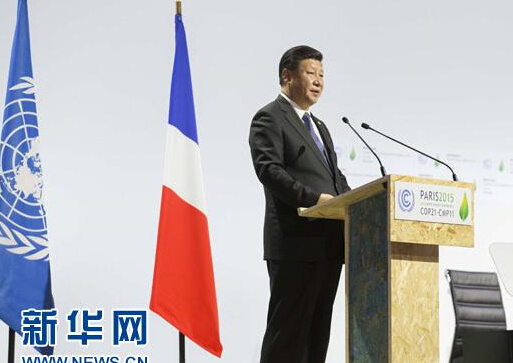
President Xi Jinping attended the opening of Paris Climate Change Conference and delivered and important speech on Nov. 30,2015. [Photo/Xinhua] |
The historic agreement passed at the Paris climate change conference compels all countries for the first time to reduce greenhouse gas (GHG) emissions that cause global warming. In particular, the agreement aims to keep global average temperature rise to below 2 degrees Celsius above pre-industrial levels on the basis of equity and common but differentiated responsibilities of countries and their respective capabilities.
Conveying the global leaders' unanimous determination to take climate action, the Paris deal also established the mechanism, framework and architecture for enhanced actions before and after 2020. Retroactive scientific evaluation will be routinely conducted to review the Intended Nationally Determined Contributions of all the parties to the United Nations Framework Convention on Climate Change.
As one of the world's largest GHG emitters, China actively engaged in a slew of bilateral and multilateral climate negotiations before and during the Paris climate conference. Its extensive diplomatic efforts include the two China-US joint statements on climate change, in November 2014 and September 2015, as well as the China-France statement on climate change issued earlier last month. And three months ago, it announced the establishment of an independent South-South cooperation fund of 20 billion yuan ($3.1 billion) to help developing countries fight and adapt to climate change.
At the Paris climate conference, President Xi Jinping pledged to launch cooperation projects next year to set up 10 pilot low-carbon industrial parks, start 100 mitigation and adaptation programs in other developing countries, and offer training opportunities to 1,000 of their representatives.
He also reiterated that China's INDC, submitted to the UN in June, aims to cut its carbon emissions per unit of GDP by 60 to 65 percent from the 2005 level by 2030, and increase the mix of non-fossil fuel sources in its primary energy consumption to about 20 percent and peak its carbon emissions also by 2030.
China is taking aggressive actions toward achieving the goal. For example, China started a pilot carbon-emissions trading project in 2011 in seven provinces and cities, which had a turnover of about 1.2 billion yuan by the end of August. The Chinese government is set to put its national carbon market into operation in 2017. Besides, China's 31 provinces, autonomous regions and municipalities completed their annual energy-saving tasks last year, on schedule.
It is clear that, as the world's largest developing country, China is determined to control its GHG emissions and pursue low-carbon and eco-friendly growth. And its efforts to fight climate change will have benign "spill-over" and demonstrative effects across the world in spite of the challenges it faces at home and abroad.
However, it should peak its carbon emissions as soon as possible, and strive to tap into the potential of renewable energy resources. Given that China's non-fossil fuel sources in the primary energy consumption mix last year was just more than 11 percent, it might need at least 1.2 billion tons of standard coal-almost 2.5 times the renewable energy generated in 2014-to fulfill the INDC commitments.
In other words, China's energy consumption after the peak will basically be confined to non-fossil fuel sources. Therefore, sustaining the post-peak growth requires an optimized energy structure in which renewable fuel sources should play a major role.
The nationwide promotion of pilot carbon-trading projects, too, have to be carried forward efficiently to trigger fundamental changes in the local development approach-from high-carbon to green and low-carbon.
The synergies embedded in the implementation of the 13th Five-Year Plan (2016-20)-which features low-carbon development, energy conservation and emission reduction-are expected to help China get closer to its INDC goals. Since reducing the consumption of fossil fuels can improve the air quality and mitigate climate change, China ought to adopt a comprehensive evaluation system to keep track of and assess how relevant policies are working.
The author is the China Climate Program Lead, World Resources Institute.


I’ve lived in China for quite a considerable time including my graduate school years, travelled and worked in a few cities and still choose my destination taking into consideration the density of smog or PM2.5 particulate matter in the region.
Copyright 1995 - . All rights reserved. The content (including but not limited to text, photo, multimedia information, etc) published in this site belongs to China Daily Information Co (CDIC). Without written authorization from CDIC, such content shall not be republished or used in any form. Note: Browsers with 1024*768 or higher resolution are suggested for this site.
License for publishing multimedia online 0108263 Registration Number: 130349