 |
|
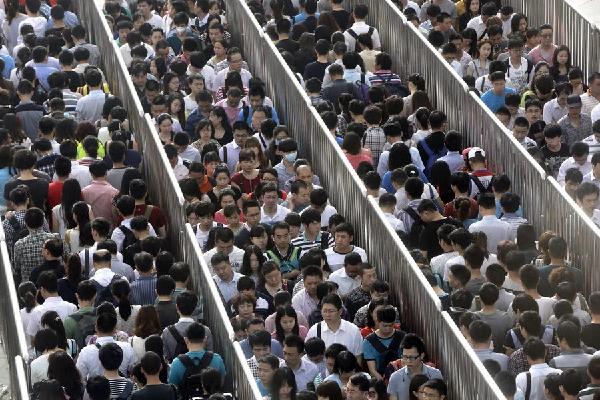
Passengers line up and wait for a security check during morning rush hour at Tiantongyuan North Station in Beijing on May 27, 2014. [Photo/Agencies] |
The year 2015 will be of special importance to China in terms of population policy because it has seen a milestone revision to the family planning policy. In 2014, one after another province adopted detailed regulations to implement the decision of the country's top leadership in 2013 to allow couples to have two children if even one of them was the only child of his/her parents. But contrary to expectations, only 1.85 million couples in the country, or 16.8 percent of the 11 million eligible couples, had applied by October 2015 to have a second child.
At the Fifth Plenum of 18th Communist Party of China Central Committee in November, the top leadership decided, in principle, to allow all couples to have two children, pending the revision of the family planning law by the National People's Congress Standing Committee.
Since the beginning of 2015, questions were raised about the possible revision of the family planning policy because fewer and fewer couples want to have two children. Many surveys have shown that few ordinary couples dare to have a second child because the financial cost of raising children is very high. If that indeed is the case, the initial purpose of revising the family planning policy, that is, to offset the effects of China's aging population in order to have enough working-age people, is not likely to be fulfilled.
Whether or not the easing of the family planning policy can solve the problem depends on whether the fertility rate will effectively increase, or, to put it more simply, whether more couples will have two children.
It should be noted, however, that China did not implement the strict family planning policy, which allowed a majority of the couples to have one child, until the late 1970s. So the majority of the single children were born in that decade or later. And since the revised family planning policy in 2014 has already allowed many couples from these generations to have a second child, the change in 2015 will not make a big difference. This is because the majority of them are in their 20s or early 30s, an age when people do not favor more than one child owing to their focus on careers.
Also among the group eligible to have two children are financially stable couples, but the problem is that they are in their late 30s or early 40s, not the age ideal to have children. So only if the State takes some special measures to encourage them to have a second child can the general fertility rate be raised.
Perhaps the experiences of Singapore and South Korea can help. Singapore first tried to raise the fertility rate in 1987 and South Korea in 2004, and their special measures to achieve the goal included subsidies, tax cuts for families with multiple children, as well as setting up more public-funded baby centers. But these policies stimulated the fertility rate in the short term only, without succeeding in reversing the declining fertility rate in the long run. Therefore, if China wants its new policy to be effective, it has to adopt more policies to encourage people to have two children.
On Dec 21, the NPC Standing Committee began reviewing the draft amendment to the family planning law, which says the State encourages couples to have two children by granting women longer pregnancy leaves and couples other welfare benefits.
This shows the State is really determined to make the revised policy a success, because it "encourages" instead of merely "allowing" couples to have two children. So if the draft is approved, we hope it, along with other measures, will offset the effects of the aging population.
The author is an associate professor at the School of Social Development and Public Policy, Fudan University.


I’ve lived in China for quite a considerable time including my graduate school years, travelled and worked in a few cities and still choose my destination taking into consideration the density of smog or PM2.5 particulate matter in the region.
Copyright 1995 - . All rights reserved. The content (including but not limited to text, photo, multimedia information, etc) published in this site belongs to China Daily Information Co (CDIC). Without written authorization from CDIC, such content shall not be republished or used in any form. Note: Browsers with 1024*768 or higher resolution are suggested for this site.
License for publishing multimedia online 0108263 Registration Number: 130349