 |
|
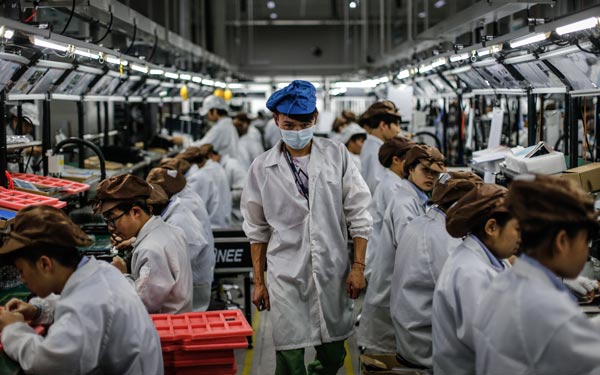
Workers at an export-oriented mobile phone parts enterprise in Dongguan, Guangdong province. [Photo/China Daily] |
The Year-end Update of the Economic and Social Survey of Asia and the Pacific 2015, published by the Economic and Social Commission for Asia and the Pacific, identifies an emerging slowdown in the region's economic growth, which has implications for Asia and the Pacific's continued ability to drive the global economic recovery. Economic growth in the region is expected to plateau at about 5 percent in 2016. The year 2015 saw only 4.5 percent growth, compared with markedly better average growth of 9.4 percent in the pre-crisis period between 2005 and 2007. Deceleration in growth does not augur well for the implementation of the 2030 Agenda on Sustainable Development, which is why effective diagnostics are the primary focus of the ESCAP update.
Four key factors have had an impact on regional economic performance, which will also have a significant global impact:
First, the continued weak recovery and sluggish demand in developed economies is driving the economic slowdown being observed across Asia, but especially in China.
Second, for the right reasons, China's endeavors to rebalance its economy by stimulating domestic consumption have — combined with restrained investment, particularly by State-owned enterprises — had a large impact. Because of the size of its economy and its role in intra-regional trade and investment, China's slowdown has had a major direct impact on growth in the economies of developing Asia and the Pacific.
Third, China's economic slowdown is also having an impact on equity and currency markets, in China as well as across the region and beyond, which in turn are having implications for wider economic and financial stability. We still believe this is essentially a financial market correction and that China's economic fundamentals remain strong. Nevertheless, China does face substantial challenges to the sustainability of its growth, such as high inequalities, rapid accumulation of private debt and serious pollution issues.
Fourth, domestic demand in the region has slowed, so Asia-Pacific economies need to prioritize the reinvigoration of both domestic and regional demand to revive growth and support sustainable development, through infrastructure investment that will generate jobs, increase the financial resources of governments and improve the overall development outcomes of Asia and the Pacific.
One way of boosting domestic demand is to tap the fiscal space that is contingent on tax and other reforms. Especially in view of the 2030 Agenda, governments will need to increase or re-prioritize expenditures. In 2015, a number of economies undertook significant fiscal spending programs, including China, the Republic of Korea, Fiji, the Philippines, Russia and Thailand. Fiscal policy can tackle cyclical and long-term challenges, and relieve pressure on monetary policy, provided that tax revenues are strengthened.
In many developing economies there is also further potential for stronger domestic demand due to favourable population dynamics, rapid urbanization and a growing middle class. However, despite its potential to contribute to growth in the region, domestic demand in several economies has not seen robust growth. High household debt is one factor holding back domestic consumption in, for instance, Malaysia and Thailand. Rapid increases in private debt in these economies call for vigilance, especially as financing costs are likely to increase in the region. In other economies, such as Russia and Indonesia, elevated levels of inflation and currency depreciation are also having a negative impact on consumption.
Growth can be boosted, for example, by improving regional productivity, which has been falling since 2008, and making it more inclusive. In doing so, it is also particularly important for the benefits of improved productivity to be more equitably shared with workers, by translating these into real wage increases. This would contribute to strengthening domestic and regional demand. Economic growth supported by increases in real wages is more resilient than growth backed by the accumulation of debt.
The author is an under-secretary-general of the United Nations and executive secretary of the Economic and Social Commission for Asia and the Pacific.


I’ve lived in China for quite a considerable time including my graduate school years, travelled and worked in a few cities and still choose my destination taking into consideration the density of smog or PM2.5 particulate matter in the region.
Copyright 1995 - . All rights reserved. The content (including but not limited to text, photo, multimedia information, etc) published in this site belongs to China Daily Information Co (CDIC). Without written authorization from CDIC, such content shall not be republished or used in any form. Note: Browsers with 1024*768 or higher resolution are suggested for this site.
License for publishing multimedia online 0108263 Registration Number: 130349