As a cold front sweeps across China, comments such as "people should be given higher wages, as they need heavy jackets and heaters to avoid freezing" have become popular online.
But for street cleaners and other workers laboring in the open air, the cold weather is not a joke. While others enjoy modern heating system indoors, they are laboring outside in freezing conditions. In Shenyang, capital of Northeast China's Liaoning province, it can be 20 degrees Celsius indoors and minus 16 degrees outdoors - two different worlds.
Outdoor working conditions will further worsen over the weekend and many provinces will see their lowest recorded temperatures in years.
Temperatures in Beijing dropped to minus 10 degrees Celsius on Friday and are expected to hit a 30-year low of minus 17 degrees Celsius on Saturday. And highways in at least 12 provinces and municipalities have been closed due to blizzards and snowstorms.
All these make a subsidy for outdoor laborers necessary. As early as 2004, a national minimum wage regulation required employers to offer a low-temperature subsidy to outdoor workers. Yet in reality they seldom get it.
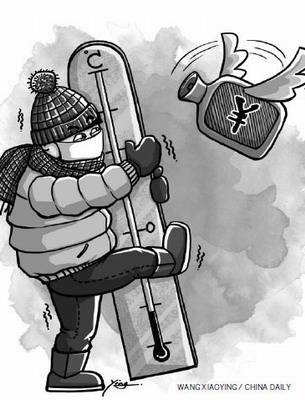
According to reports in several northern provinces, only a very few street cleaners received an additional 200 yuan ($30.44) monthly low-temperature subsidy they are entitled to. While some of them have received a heavy jacket or a bag of rice, most simply get nothing. It has been said the subsidies are "just a right on paper".
There are several reasons employers do not pay the low-temperature subsidies they are obligated to. One is, the regulation that defines the subsidies does not include specifics on their implementation. It only states that employers should offer subsidies for those working in "special working environments", including high and low temperatures but without setting any standards.
Also, the regulation does not include any punishments for those failing to provide the subsidies, which is why many enterprises don't bother paying them. As a labor protection official in Qingdao, Shandong province, said in an interview, the regulation "does not sound mandatory" so many enterprises simply ignore it.
The Ministry of Human Resources and Social Security recently said that enterprises should "independently" decide whether to pay low-temperature and other subsidies and they only "encourage" and "offer policy guidelines to" enterprises. By saying this, they are actually shrugging off their duty.
The fact that most outdoor laborers, such as street cleaners and construction workers, are migrant laborers has worsened the situation, since this vulnerable group lacks effective channels to put pressure upon their employers.
Unlike the low-temperature subsidy, the high-temperature subsidy became a topic for public discussion in July 2012, when temperatures soared and the media highlighted the issue.
The central authorities amended a 1960 version of regulation, which was rather weak, and strengthened supervision over payment of the high-temperature subsidy in that month, as a result of which the subsidy has become a common practice nationwide.
Now the low-temperature subsidy is getting similar public attention, it is to be hoped the government will also make efforts to ensure it is paid and add punitive measures to the regulation to deter employers from not fulfilling their obligation.
However, revising a law is not something that can be done overnight and plummeting temperatures are already on the way; so something needs to be done now.
Frostbite was added to the list of occupational diseases in 2013 in a document issued jointly by the health, production safety and human resources authorities and the trade unions. In 2015 low temperature was added to the official list of factors leading to occupational hazards. Authorities can use this as legal support for requiring enterprises to provide low-temperature subsidies to outdoor laborers. And they should do so quickly as there is little time to wait.
The writer is with China Daily.
zhangzhouxiang@chinadaily.com.cn


I’ve lived in China for quite a considerable time including my graduate school years, travelled and worked in a few cities and still choose my destination taking into consideration the density of smog or PM2.5 particulate matter in the region.
Copyright 1995 - . All rights reserved. The content (including but not limited to text, photo, multimedia information, etc) published in this site belongs to China Daily Information Co (CDIC). Without written authorization from CDIC, such content shall not be republished or used in any form. Note: Browsers with 1024*768 or higher resolution are suggested for this site.
License for publishing multimedia online 0108263 Registration Number: 130349