 |
|
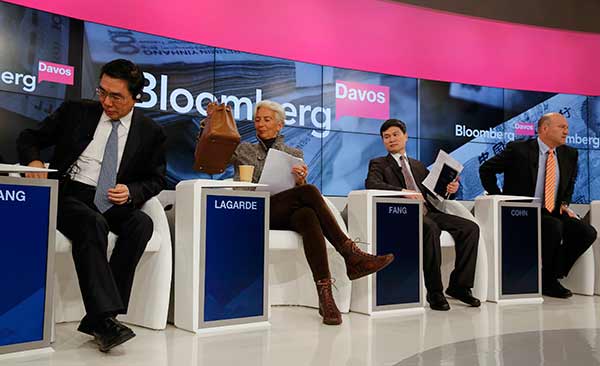
Jiang Jianqing, chairman of the board, Industrial and Commercial Bank of China, Christine Lagarde, managing director, International Monetary Fund (IMF), Fang Xinghai, director-general, International Economic Department, Office of the Central Leading Group for Financial and Economic Affairs of China and Gary D. Cohn (L-R), president and chief operating officer, Goldman Sachs, arrive for the session 'Where Is the Chinese Economy Heading?' of the annual meeting of the World Economic Forum (WEF) in Davos, Switzerland January 21, 2016.[Photo/Agencies] |
There has been a great deal of anxiety recently among global investors and financial experts over the state of the Chinese economy. This appears to have reached its peak during the 2016 World Economic Forum at Davos, where George Soros opined that China is facing a 'hard landing' because of mismanagement of its currency and other factors, provoking a furious rebuttal in the pages of this newspaper and elsewhere in the Chinese media.
Other major Western media outlets such as The Economist and The Wall Street Journal have weighed in with negative forecasts of China's economy. Even Goldman Sachs, the US investment bank, has warned its clients to withdraw from China because of the possibility of imminent economic collapse.
Now it seems that calmer heads in the Western financial community have begun to urge people not to succumb to unnecessary panic, given that the data do not warrant such an extreme reaction. Ambrose Evans-Pritchard of the UK's The Daily Telegraph has advised against what he calls the 'hysteria' which he believes has replaced rational debate both outside and within China.
Yet there still seems to be great confusion over the direction of China's economy among Western financial and economic experts. Some claim a devaluation of the yuan is imminent, others deny it. There appear to be almost as many versions of China's economic future as there are experts.
Thus the situation is one of turmoil, both in the markets but also in people's heads. Part of this disorder is generated by the difficult transformation that is currently occurring in China's economy, as this continent-sized nation of 1.3 billion attempts the inevitable shift from industrial production to a service economy that is unprecedented in human history in terms of size.
However, part of the problem is also now being enabled by an emerging climate of fear, at least in part generated by Western media and financial pundits.
Economics is unfortunately not a precise science, and is subject to the highs and lows of human emotions at least as much as it is to the influence of numbers. Many have noted that markets move up and down on waves of greed and fear.
The present wave of unjustified fear and the scaremongering it has entailed is indicative of three things. The first is that it is clear evidence that China is now the most significant driver of global economic growth. There is now a largely unspoken recognition in the West that what happens in China is going to affect the futures of the whole of humanity in the twenty-first century.
The second point is that this tacit admission of China's central significance to the world, delivered in a flurry of prognostications about China's economy, betrays the sense of misgiving that many in the West have about China's increasing global importance. Fear about China's economy also reveals an underlying anxiety that China is on the cusp of replacing the West as the dominant historical force of our time, and that this development, whatever its end result may turn out to be, is beyond the control of Westerners.
The third and last issue is that, in all probability, large Western financial institutions suspect that the global economy may be on a downward spiral because they know full well that they have not sufficiently reformed their practices since the 2008 meltdown, and that due to their continuing malpractice (well-documented and subject to fines for banks such as HSBC in the billions of dollars) there is likely to be another banking crisis on the cards before long.
In short, the 'panic' (if such it be) among financial pundits at Davos and elsewhere is indicative of a deep-seated mistrust of China, what it stands for, and where it is headed, as well as a desire to pre-emptively pass the buck if another crash comes.
Jeremy Garlick is lecturer in international relations at Jan Masaryk Centre for International Studies, University of Economics in Prague.
The opinions expressed here are those of the writer and don't represent views of China Daily website.


Copyright 1995 - . All rights reserved. The content (including but not limited to text, photo, multimedia information, etc) published in this site belongs to China Daily Information Co (CDIC). Without written authorization from CDIC, such content shall not be republished or used in any form. Note: Browsers with 1024*768 or higher resolution are suggested for this site.
License for publishing multimedia online 0108263 Registration Number: 130349