 |
|
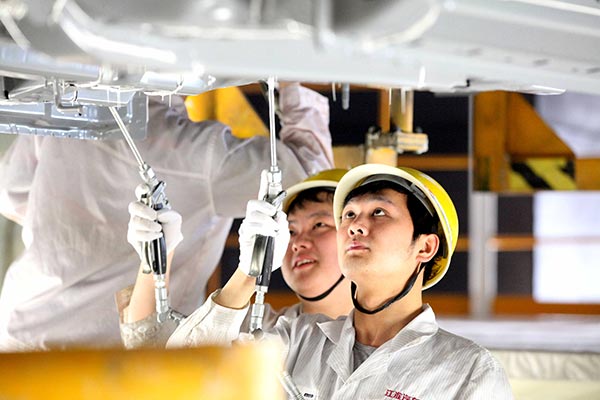
Workers at the production line of Anhui Jianghuai Automobile Co Ltd in Hefei, capital of Anhui province. [Photo/China Daily] |
China's GDP grew by 6.9 percent in 2015, the lowest since 1990, the National Bureau of Statistics announced on Jan 19. But some economists doubt whether the Chinese economy grew at that rate given the poor performance of the stock market, the yuan's depreciation, and a series of poor economic data.
The turbulence in the Chinese stock market since the start of this year once again proves that rather than being a reliable economic barometer it is basically independent of economic fundamentals. The stock market's performance over the past few years, especially the last 19 months, shows it has been increasingly deviating from the real economy - basically chasing the trajectory of a fictitious economy. Since the stock market has been frequently driven by conceptual and short-term speculation, it should not be used a yardstick to determine the health of the Chinese economy as a whole. Instead, fundamental economic indicators should be used to diagnose the state of China's economy.
The serious industrial overcapacity and excessively high real estate inventory, combined with the government's central task of reducing capacity and stock in 2016, have raised fears of a drastic drop in the GDP growth rate.
But analyses of all the 41 industrial sectors will show only eight of them are suffering from heavy overcapacity and negative growth. The newly emerging and high-tech industries, including information technology, telecommunications and electronics, aerospace, railroad rolling stocks and pharmaceuticals are all performing well. And the traditional industries, including food processing, textiles and apparel, furniture, leather goods, rubber and plastic products, and automobiles and auto parts, are growing steadily. The latter two categories are apparently not suffering from heavy overcapacity.
The efforts to reduce overcapacity, therefore, will be directed at a minor part of the industrial chain, which is not likely to bring down overall industrial growth. On the other hand, the emerging and high-tech sectors are likely to accelerate and thus lift the potential growth rate of all industries, with the traditional sectors, including the chemical industry, staying mostly stable. As such, industrial growth as a whole is likely to be only slightly slower in 2016. More importantly, there is no danger of a major slump.
In the tertiary sector, the supply-side reform will only accelerate the supply of public goods and services, including education, healthcare, recreation and telecom. The real estate sector, however, will witness major de-stocking, which could add uncertainty to the growth prospect.
On the demand side, the contribution of consumption to GDP growth will tend to increase while that of investment will continue to fall, with the role of net exports remaining unclear.
Since total sales of consumer goods in China have a higher share of GDP than in the US, and retail sales, online shopping, travel and tourism, and consumption in the cultural and telecom fields are all growing steadily, there is no threat of a drastic slowdown. Consumer goods sales, in fact, are expected to contribute 3.50-4.0 percent to GDP growth this year.
The contribution of fixed investment to GDP growth has been falling in recent years, and this year it is most likely to be below 3.0 percent. Besides, the world commodity and oil markets will not see any fundamental improvement in 2016, which means China's trade pattern will remain similar to that of 2015.
In short, China's downward economic trend will continue for some time in 2016, and the overall growth rate will be even lower than that in 2015. The economic fundamentals, however, justify predicting a steady growth rate of 6.5-6.8 percent, depending on the progress of the reform and restructuring, and the developments in the global economy. In any event, a major slump, or "hard landing", seems out of the question.
The author is co-director of the China-US/EU Study Center at the China Association of International Trade.
Courtesy: chinausfocus.com


I’ve lived in China for quite a considerable time including my graduate school years, travelled and worked in a few cities and still choose my destination taking into consideration the density of smog or PM2.5 particulate matter in the region.
Copyright 1995 - . All rights reserved. The content (including but not limited to text, photo, multimedia information, etc) published in this site belongs to China Daily Information Co (CDIC). Without written authorization from CDIC, such content shall not be republished or used in any form. Note: Browsers with 1024*768 or higher resolution are suggested for this site.
License for publishing multimedia online 0108263 Registration Number: 130349