 |
| Li Min/China Daily |
A man in Central China's Henan province tried, in vain, for four months to get a hukou (household registration) for his newborn son from a local public security bureau. He then presented 200 yuan ($31) to the police officer in charge of the matter and, within two days, got the registration completed.
Another man, just released from prison, said he had to give presents to the guards from time to time to avoid being harassed by them in prison. And a senior official in Nan'an, South China's Fujian province, got an earful from his wife for failing to use his connections to get his son admitted to a "better" school.
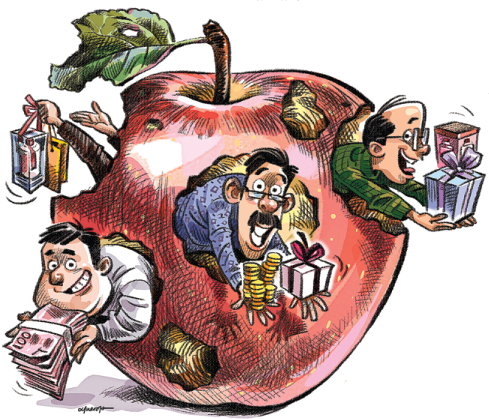
The three cases mentioned in a recent report of China Disciplinary Inspection and Supervision News, the official publication of the country's top anti-corruption watchdog, are quite common in everyday life. The report also said a type of "corruption subculture", which thrives on "hidden rules", permeates society.
Stories of doctors receiving hongbao, or red envelopes containing gift money, from patients for a surgery are no longer news nor are tales of candidates showering examiners with gifts to get a driving license. The "corruption subculture", like "spiritual smog" covering every aspect of life, is eroding the normal order of society.
When most people believe that by following the normal procedure they cannot get even routine things done and, hence, resort to bribing officials or using their connections, it means something is seriously wrong with the existing social norms.
The central leadership has launched an unprecedented anti-corruption drive, which has brought down a large number of "tigers and flies", or high-ranking and lower-level corrupt officials. Indeed, the leadership is determined to clean the Party and government, but it should pay attention to the "corruption subculture" too.
If people grow up in a culture in which the use of money as "social lubricant" is rampant, taking bribes and favors by officials will become an accepted practice. The source of the "corruption subculture" is unchecked powers of officials.
Grassroots police officers, prison guards and doctors may not be important enough to be called even "flies", but it is the resources they have at their disposal that make abuse of power possible. The money or presents they demand or take may not be big enough to land them in jail, but bit by bit they will continue to contribute to the "corruption subculture", which will lead to greater and more damaging corruption.
While people are infuriated to see the appalling facts after a corrupt official is caught, how many can say they haven't done anything to help corruption flourish? People who bribe officials to get things done and thus become part of the "corruption subculture" risk violating law themselves. One has to ask oneself: Do you have the will to resist temptation? Or, will you become corrupt if you get the opportunity?
This "corruption subculture" cannot be eradicated if people continue to involuntarily follow the "hidden rules" to get things done.
The top leadership has vowed to keep power "within the cage" of systematic regulations. It has also been pushing forward the work of streamlining administrative approval processes to cut red tape to reduce the power of the government, a move applauded by all. But strengthened supervision for people who exercise power is also essential for preventing abuse of power.
Moreover, public resistance to these "hidden rules" is also necessary to eradicate corruption.
The fight against corruption is high on the agenda of the deputies to the National People's Congress and members of the National Committee of the Chinese People's Political Consultative Conference attending the twin annual sessions in Beijing. The deputies and members, who hail from all walks of life and from across the country, can play a leading role in finding ways to end the "corruption subculture" once and for all.
The writer is an editor of China Daily. lifangchao@chinadaily.com.cn


I’ve lived in China for quite a considerable time including my graduate school years, travelled and worked in a few cities and still choose my destination taking into consideration the density of smog or PM2.5 particulate matter in the region.
Copyright 1995 - . All rights reserved. The content (including but not limited to text, photo, multimedia information, etc) published in this site belongs to China Daily Information Co (CDIC). Without written authorization from CDIC, such content shall not be republished or used in any form. Note: Browsers with 1024*768 or higher resolution are suggested for this site.
License for publishing multimedia online 0108263 Registration Number: 130349