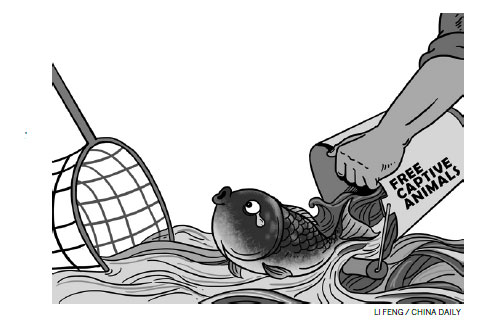
Some believers in Buddhism released about 300 arctic foxes and minks in the mountains north of Beijing late last month. Soon a farmer reported to local officials that foxes had killed three of his chickens, and local forestry police started a hunt for the animals. By April 13, police had found about 100 foxes, of which more than 40 had starved to death.
The practice of setting animals free is not new. Buddhists have been releasing animals in the wild for ages, apparently to save them from slaughter or being "exploited" by their human masters. But even if police found the people who set the animals free, there is no law to hold them accountable for the troubles they have caused, albeit wittingly, to the local residents.
For Buddhists, setting animals free is regarded as a means of salvation (or an act of penance). If it is done on an auspicious day according to the Buddhist calendar, the deed becomes more virtuous, which in their belief can strengthen a person's chances of going to heaven after death, or help cleanse his/her sins. Although there are many schools in Buddhism, releasing animals from bondage or captivity is a common practice among all.
Fish, turtles, birds, snakes and foxes are the most popular choice of animals for the purpose, as they are easily available in captivity, or as pets. But the people who release such animals are usually not bothered about whether they can survive in the wild. Unfortunately, most animals raised on farms, or in homes, cannot adapt to the harsh conditions in the wild. They cannot hunt or protect themselves against their natural predators. If that is the case, don't Buddhists, by releasing such animals in the wild, push them closer to death?
Worse, such people sometimes introduce invasive species into the wild. And as is their wont, invasive species pose a threat to indigenous species. For example, snapping turtles and red-eared sliders, turtles found in the natural state only in North and Central America and which have no natural predators in China, have broken the ecological balance in some parts of China after being released in the wild by people seeking salvation.


I’ve lived in China for quite a considerable time including my graduate school years, travelled and worked in a few cities and still choose my destination taking into consideration the density of smog or PM2.5 particulate matter in the region.
Copyright 1995 - . All rights reserved. The content (including but not limited to text, photo, multimedia information, etc) published in this site belongs to China Daily Information Co (CDIC). Without written authorization from CDIC, such content shall not be republished or used in any form. Note: Browsers with 1024*768 or higher resolution are suggested for this site.
License for publishing multimedia online 0108263 Registration Number: 130349