 |
| WANG XIAOYING/CHINA DAILY |
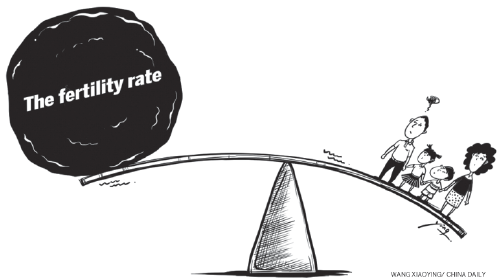
A rather remarkable turnaround has occurred in China. For a country famous for having the most comprehensive sets of policies designed to limit births, it is now introducing new policies to support parents who have a second child-from a planned tax relief to possible extension of maternity leave and expansion of free education.
For some time now, studies have observed family planning officials in some large cities actively encouraging couples to take advantage of their rights to have a second child. In this way, local governments could become ever more proactive in designing policies to support couples to have a second child.
Governments across the Asia-Pacific region have been introducing increasingly far-reaching policies in recent years to support and encourage childbearing in an attempt to stem extremely rapid aging resulting from very low fertility rates. Perhaps the most expansive and famous is in Singapore. Elsewhere, policies to support childbearing both financially and in terms of childcare and parental leave have been introduced in Japan and the Republic of Korea.
Yet in each of these settings fertility has stayed resolutely low; not least in Singapore which has one of the lowest fertility rates in the world. This is because the financial subsidies simply do not come close to offsetting the high costs of childbearing in these countries.
Costs are further exaggerated by expectations of huge investment in education and other activities, sometimes called "education fever". These policies are also not able to adequately address some of the more fundamental reasons for limiting family sizes, such as fragile employment and the "triple burden" placed on women to work and take primary responsibility for both children and elderly parents.
There is now a broad agreement that it is not just the one-child policy which pushed-and kept-fertility down in China. As such, just changing the policy is likely to have only a limited impact.
Assuming, though, that many of the other reasons for low fertility are common to both China and elsewhere in Asia, and given the limited success in other countries and regions in turning birth rates around, we might question how effective policies to support childbearing will be at increasing the Chinese fertility rate.
This, I think, misses the point. If the new policies were set out to encourage childbearing in order to achieve certain key population "goals", then they may well not succeed. But the language of the new policy announcement does not appear to suggest this. In a break from the "old" way of talking about family planning, the "new" language is much more about "supporting" than "encouraging".
This is not just semantics. If the new policies are designed to support citizens to be able to meet their aspirations in terms of family, work and life, then their success should be judged on this rather than the birth rate in years to come.
Switching from the world's most restrictive family planning regime to offering incentives for childbirth is a remarkable turnaround. But it may well be that the truly revolutionary aspect of this policy change is the switch from "shaping" citizens' actions to meet the needs of the nation toward "supporting and enabling" them to meet their own personal aspirations.
The author is an associate professor of social policy, Department of Social Policy and Intervention, University of Oxford.


I’ve lived in China for quite a considerable time including my graduate school years, travelled and worked in a few cities and still choose my destination taking into consideration the density of smog or PM2.5 particulate matter in the region.
Copyright 1995 - . All rights reserved. The content (including but not limited to text, photo, multimedia information, etc) published in this site belongs to China Daily Information Co (CDIC). Without written authorization from CDIC, such content shall not be republished or used in any form. Note: Browsers with 1024*768 or higher resolution are suggested for this site.
License for publishing multimedia online 0108263 Registration Number: 130349