 |
|
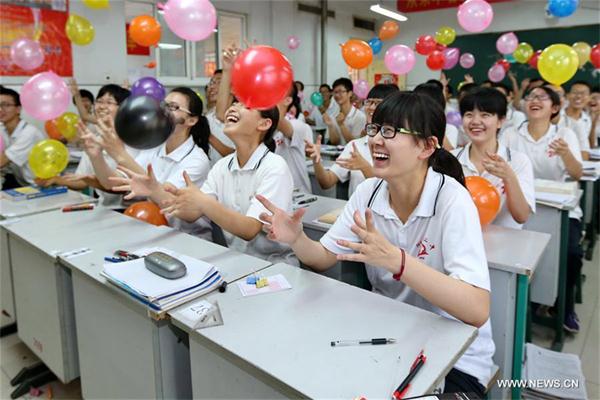
Senior high school students play with balloons to reduce stress at No 2 High School in Hengshui, North China's Hebei province, May 22, 2016. With the three-day 2016 college entrance exam beginning on June 7, students have entered the sprint stage of their studies. [Photo/Xinhua] |
The compulsory education for non-resident children in big cities is always a hot topic for debate at this time of year, because even as people call for greater fairness, the demand for school places in first- and second-tier cities is continually growing and, as a result, local education authorities apply ever stricter criteria for non-resident children's enrollment in their schools.
This year, Beijing's education authorities have reiterated that they will enable every "qualified" child to enjoy local compulsory education. By "qualified" they are referring to a minimum of "five certificates" that the non-resident families must have: a child's parents or guardians must have Beijing employment certificates, Beijing residency certificates, a household registration booklet, a Beijing temporary residence permit and a certificate from the place where the family is registered that there is no one who can care for the child there.
Some districts of Beijing, impose even more criteria. For instance, the education authorities in Miyun district stipulate that besides the "five certificates" non-resident children's parents must have paid social security premiums in Miyun district for more than one year, while the education authorities in Shijingshan district have said priority in school enrollment for qualified non-resident children will go to those families that have purchased property in the district.
The restrictions on compulsory education enrollment for non-resident children are only some of the capital's population control policies in recent years, as it seeks to ease the pressure on public services.
And Beijing is not alone in implementing such policies. For big cities that offer the best hospitals and schools, as well as the best job opportunities, the question is not whether they are willing to offer equal resources, but how many people they can afford to provide them to.
The metropolises have already reached their population carrying capacities. At the end of 2015, for example, Beijing's resident population had officially reached 21.7 million, of which 8.23 million were non-native residents. The city's education resources are feeling the pressure.
Some people argue that it is unfair to treat children differently at the compulsory education stage depending on where their household is originally registered. But the fundamental problem behind this unfairness is limited resources.
Imagine the household registration system is abolished in one fell swoop, the foreseeable result is a huge and sudden influx of people into the biggest cities. Obviously it would be impossible for the local authorities to deal with such a situation.
Like many "unfair" social problems in China, the issue of compulsory education enrollment for non-resident students results from the unbalanced development in various regions.
On the one hand, striving for a better life is human nature, thus it is reasonable that people head for places with better resources and better opportunities. On the other hand, the residents already there are inclined to safeguard whatever they have.
But it doesn't help simply blaming some people for being "selfish" for wanting to hold onto the resources they enjoy when those resources are limited. But different from other issues stemming from the country's unbalanced development, non-resident children do not voluntarily come to the big cities themselves, they come because that is where their parents are.
So the issue of non-resident children's education is really part of the unbalanced employment situation in the country.
In most cases, people come to work and live in the big cities from elsewhere because there are more job opportunities. For some people who were born in the countryside and received education in the urban areas, even if they want to go back to their rural hometowns there are few job opportunities that provide a salary commensurate with their education level.
Dealing with these social problems at the root may sound like a cliché but it is only way to remedy the situation. Only when the authorities improve the overall situation of the less developed regions will the large-scale population migration to big cities slow.
The author is a writer with China Daily. wangyiqing@chinadaily.com.cn


I’ve lived in China for quite a considerable time including my graduate school years, travelled and worked in a few cities and still choose my destination taking into consideration the density of smog or PM2.5 particulate matter in the region.
Copyright 1995 - . All rights reserved. The content (including but not limited to text, photo, multimedia information, etc) published in this site belongs to China Daily Information Co (CDIC). Without written authorization from CDIC, such content shall not be republished or used in any form. Note: Browsers with 1024*768 or higher resolution are suggested for this site.
License for publishing multimedia online 0108263 Registration Number: 130349