 |
|
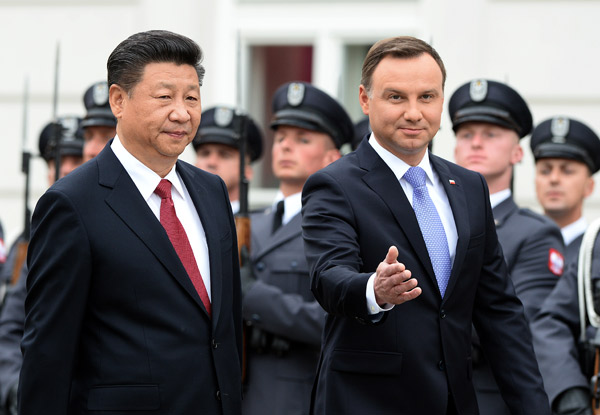
President Xi Jinping and his Polish counterpart Andrzej Duda review an honor guard during a welcoming ceremony at the presidential palace in Warsaw on Monday. JANEK SKARZYNSKI / AFP |
President Xi Jinping is on the road again to Serbia, Poland and Uzbekistan conducting bilateral diplomacy, as well as multilateral relations at the Shanghai Cooperation Organization. Much of the visit will be trade-related in pursuit of the President’s One Belt and One Road (OBOR) initiative. This initiative provides significant economic stimuli to the Chinese economy and strengthens friendship for China by funding infrastructure and other projects with OBOR countries.
The scale of this initiative is breathtaking: Sixty-five countries and 4.4 billion people. OBOR is buttressed by the $40 billion Silk Road Infrastructure Fund, Asian Infrastructure Investment Bank (AIIB) with registered capital of $100 billion, and BRICS New Development Bank with eventual capital of $100 billion. OBOR has rightly been called "the most significant and far-reaching initiative that China has ever put forward."
During his visits President Xi will pursue the three OBOR "together's." Discussion by the parties to identify projects of cooperation for mutual benefit, working together to realize the projects based on common interests, and enjoying the benefits together from the fruits of this common endeavor. This is win-win cooperation at its best.
While I don't believe that OBOR and the huge financial arsenal backing it on their own will solve China’s economic problems related to over-production and over-capacity, they have already won friends on a scale never seen before.
OBOR has five broad goals of policy coordination; facilities connectivity; unrestricted trade; financial integration; and building networks of multilateral and bilateral people-to-people connections.
Most discussions of OBOR focus on the first four. I want to touch on the fifth as it's much less discussed, but of critical importance. As President Xi told the Boao Forum in 2015, OBOR will "promote inter-civilization exchanges to build bridges of friendship for our people, drive human development and safeguard the peace of the world."
China has certainly been trying harder to win hearts and minds but with mixed success. China has more to do to tell its story better and exercise its soft power by sharing its rich, venerable culture.
One unfolding success is China's collaboration with Hollywood. China is hungry for its engaging stories to get known by international audiences. Hollywood, having perfected the science of filmmaking and promotion, cherishes two things above all: box office receipts and other people's money. This seems like a marriage made in heaven that is starting to reap a rich harvest for China at home and abroad.
Some other efforts haven't reached full potential. Confucius Institutes around the globe, for example, have largely confined their efforts to language teaching. They could easily be so much more: Centers showcasing the best of Chinese culture. Thus far, they appear to me a squandered opportunity.
President Xi has his Chinese Dream. So do I.
The best form of soft power is clearly exercised on a people-to people basis. China arguably has the world's best social media platform: Tencent's WeChat. One of its many exceptional features is a decent language translator. Just imagine if young children along and beyond the Belt and Road could have a Chinese WeChat friend to learn about China and Chinese culture? China could start to make friends for life and reverse some of the troubling ratings it has gotten lately in public opinion surveys.
President Xi's frequent trips abroad remind me of the truly historic, monumental voyages of Ming Dynasty Admiral Zheng He, who led his state-of-the-art ships on seven treasure voyages across 30 countries in Asia and Africa, and some say to Australia and the Americas. China needs to bring to fruition the as-yet unrealized dream of building a seaworthy 21st century state-of-the-art full scale model of one of his behemoth ships that awed Marco Polo and others. Many have tried to make this dream come true - and failed. So it is likely that such a project must be undertaken or supported by the government.
What I find especially relevant and compelling was the purpose of Zheng He’s seven voyages. They were to project Chinese power and wealth to the outside world.
The traveling ship would be part interactive high-tech museum introducing visitors to the richness of Chinese culture then and now, part live entertainment center and part roving Chinese naval ambassador visiting OBOR countries and other ports-of-call by the high seas.
Imagine what an impression such a dramatic floating cultural center, high tech museum and massive ship would make. Imagine how many friends young and old would be inspired by it, awed by it, and have an indelible memory etched in their minds by it, and of the country that was master of the seas so many centuries ago.
The author is a senior adviser to Tsinghua University and former director and vice-president of ABC Television in New York.


Copyright 1995 - . All rights reserved. The content (including but not limited to text, photo, multimedia information, etc) published in this site belongs to China Daily Information Co (CDIC). Without written authorization from CDIC, such content shall not be republished or used in any form. Note: Browsers with 1024*768 or higher resolution are suggested for this site.
License for publishing multimedia online 0108263 Registration Number: 130349