 |
|
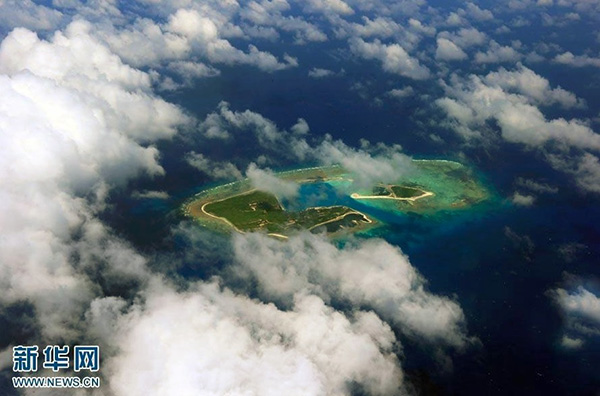
File photo of South China Sea. [Photo/Xinhua] |
The South China Sea arbitration unilaterally initiated by the Philippines against China in The Hague-based Permanent Court of Arbitration has violated many international standards of law and rules. To begin with, the arbitral tribunal does not properly identify or prove the existence of a real dispute. Also, the tribunal does not follow the world's principal legal systems.
The award on jurisdiction does not take proper cognizance of China's position. For example, China treats Nansha Islands as one single unit for the purpose of sovereignty, maritime rights as well as delimitation, but the tribunal has changed the singular "is" into the plural form "are", treating the islands and reefs in the Nansha Islands as separate units.
The award does not consider China's positions either, although it summarizes some of them superficially. For example, the tribunal summarizes China's argument that a 1995 joint statement saying the two countries would take measures with a view to "eventually negotiating" a settlement of their disputes as evincing an intent to choose negotiation only as the means to resolve disputes, but this point is absent from the part of the award called "the tribunal's decision".
Besides, the award accepts the Philippines' assertion without analyzing why its claims would not detract from China's sovereignty. The detraction is obvious from the treatment of the components of China's Nansha Islands as separate features, which would divide that archipelago into smaller units, and from a ruling that the low-tide elevations at issue, which are part of the Nansha Islands, are not subject to appropriation.
The award also superficially claims maritime entitlement and delimitation are distinct, without considering the delimitation of geographical framework and situation in the South China Sea and the associated effect of fusing distinct issues of entitlement and status of various features into a big delimitation complex, rendering these issues concerning delimitation.
Finally, the award does not respect the consistency requirement in international law. The tribunal completely ignores the "Louisa case", which is favorable to China and is directly applicable to the interpretation of China's exclusion of disputes "concerning" or "relating to" maritime delimitation as disputes over matters broader than the drawing of the line of delimitation. The arbitrator has completely changed, without offering any explanation, his previously published positions which were favorable to China. All this violates the fundamental requirement of consistency in international law and shows that the tribunal only pays lip service to its duties in arbitration.
The tribunal adopts an excessively expansive interpretation of the jurisdictional grant and distorts the text of the UN Convention on the Law of the Sea. This wrongful exercise of the "competence-competence" principle, which empowers an arbitration tribunal to rule on its jurisdiction, causes substantial damage to the international rule of law.
The competence to decide the tribunal's jurisdiction is not absolute power, and can only be exercised with genuine concern and respect for the limitations imposed by UNCLOS and for China's intents and purposes in invoking its explicit right under the convention to exclude disputes concerning maritime delimitation and historic titles.
This excessively expansive interpretation of the jurisdictional scope will present great difficulty in persuading other non-parties such as the United States to ratify UNCLOS in the future, because their greatest fear is that a court or tribunal may abuse its jurisdictional competence. This interpretation will also greatly harm the international legal system and its legitimacy.
If the tribunal and arbitrators are rational and serious, they should correct their mistakes and make up for what they have neglected to do. For example, they should correct their deliberate alteration of singular "is" used by China to describe the Nansha Islands into the plural "are", correct their mistake in not considering the delimitation geographical framework and situation in the South China Sea and the associated effect, and rectify their mistake of ignoring the rule of law requirement of consistency and in disregarding the word "concerning" in appreciating the proper scope of China's exclusion of disputes on or relating to maritime delimitation.
The author is a professor of international law and chief expert at Wuhan University Institute of Boundary and Ocean Studies.


Copyright 1995 - . All rights reserved. The content (including but not limited to text, photo, multimedia information, etc) published in this site belongs to China Daily Information Co (CDIC). Without written authorization from CDIC, such content shall not be republished or used in any form. Note: Browsers with 1024*768 or higher resolution are suggested for this site.
License for publishing multimedia online 0108263 Registration Number: 130349