 |
|
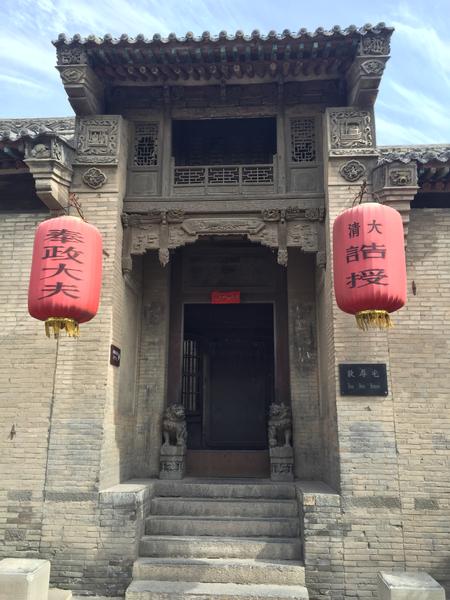
Photo shows an old door in Shanxi. [Photo by Jon GeldIart] |
I like doors. Old doors generally and wooden doors specifically. They have a texture and solidity modern doors of often plastic and glass don't have. Doors speak to me of opportunity and intrigue me in imagining what lies behind them. When usually encountered doors are tight shut, often locked and bared. Doors can separate us yet connect us when opened and stepped through. It was the doors of Shanxi province in the heart of China that spoke to me most eloquently on my recent five day trip there as a guest of the Shanxi provincial government and China Daily.
Other people take photographs of views, of people or even of the food they eat. I have to admit I do too. But my favourite subject is doors.
Shanxi is a very old province, very old indeed. There is a saying in China: 'To experience the last 30 years of China, go to Shenzhen, the last 100 years go to Shanghai, for the last 1000, Beijing, for the last 3,000 go to Shaanxi but for the last 5,000 go to Shanxi.
Needless to say the doors are old too. There was still paper, tattered and frayed, in many of the merchant shop doors of Qikou township on the banks of the great Yellow River at the far western edge of Shanxi. Here the mighty Yellow River surges past you, first to the North and then East to empty into the Bohai Sea. It was along side this river that the Chinese civilisation began and Qikou was a major crossing point for merchant traders who opened up China and at one time commanded the total monopoly over that essential and valuable commodity of salt. The trading halls are still preserved there, dimly lit through the wafer thin beige coloured, now torn and tattered, paper 'glass'.
False stone doors separated the wealthy merchant owners of the Qiao and Wang great family courtyards from their servants, allowing quiet access routes behind the scenes to support the daily necessities of business and family life. This was all brought into stark relief for me whilst watching the famous (in China at least) old film 'Raise the red lantern' directed by Zhang Yimou which was shot in the Qiao Grand courtyard. The doorways were where the concubines stood to hear which one would be chosen for that night and stand the chance of bearing a son and so secure her, and her own family's, future status. I stood there too and tried to imagine the scene as they stepped in, or out, of favour.
A short drive South West from the Qiao family courtyard brings you to the amazing old town of Pingyao. With walls that date from 1370 and which stretch, at a height of around 12m, for a distance of 6.4 km, it is a truly astonishing place and a UNESCO world heritage site. It was here that the first true banks emerged in China and stepping through the door into the old trading office is a time warping experience.
The furniture and fittings are still there but much is reconstructed, except the doors, which appear to be original. As I ran my fingers over the wood I could imagine the hustle and bustle of the Ming Dynasty traders and bankers. These doors would have opened and shut on so many transactions and seen such immense trade. It takes only a little imagination to counjour up images of silk garbed merchants stepping through the low portal and over the omnipresent door board to do business.
With over 4,000 well preserved buildings from the Qing and Ming dynasties (1368 - 1911) old and older merge in the streets to make for a mind blowing sense of history. Needless to say, there are lots of doors, many, inevitably new as the reconstruction, so common in Chinese archaeological sites of significance, continues.
However, down the back streets and away from the tourist honey pots lie old and original doors from the early Qing period. No hinges, but wooden plugs, integrated into the doors themselves, slot into neatly carved holes in the upper lintel and lower step board. This 'swing hinge' design can be found all over China but it was in such profusion, scale, and size here that I was transported back to the days of Qing and Ming when hand carts and pole carriers teemed through the streets whilst merchants and traders rubbed shoulders with ordinary townsfolk.
The trip was memorable in so many ways but I am left with the feeling that Shanxi is a misunderstood and missed out province. It's only a short train ride from Beijing and now an even shorter flight since the opening of the new airport at Luliang. At a pinch it could be a long weekend away from Shanghai or Beijing and there are also flights to Hong Kong. I know we all focus on the cities of Beijing, Shanghai and Xi'an for our history 'fix' but divert your gaze to Shanxi as a genuine alternative. You may be surprised at what doors open for you!
Jon Geldart is the Executive Director of Grant Thornton International Ltd. in Greater China and author of two books on China: 'The Thoughts of Chairmen Now' 2012, and 'Notes from a Beijing Coffee Shop' 2015.


Copyright 1995 - . All rights reserved. The content (including but not limited to text, photo, multimedia information, etc) published in this site belongs to China Daily Information Co (CDIC). Without written authorization from CDIC, such content shall not be republished or used in any form. Note: Browsers with 1024*768 or higher resolution are suggested for this site.
License for publishing multimedia online 0108263 Registration Number: 130349