 |
|
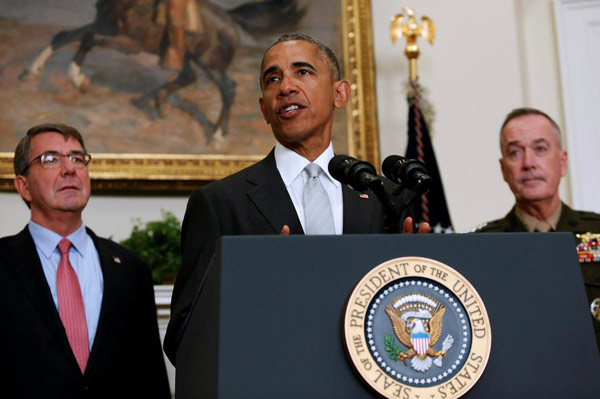
US President Barack Obama, surrounded by US Secretary of Defense Ash Carter (L) and the Chairman of the Joint Chiefs of Staff USMC General Joseph Dunford, Jr., (R) delivers a statement from the Roosevelt Room on Afghanistan at the White House in Washington US July 6, 2016. [Photo/Agencies] |
The United States needs to recalibrate its strategic priorities and put the Middle East back on the top of its foreign policy agenda to counter Islamic extremism.
The root cause of rising terrorism in the Middle East in recent years has to do with US President Barack Obama's "pivot to Asia" strategy. The strategy and the US troops' withdrawal from Iraq, Afghanistan and the Persian Gulf created a huge room for the rise of terrorism and civil wars in the region.
The "pivot to Asia" strategy is influenced by multiple factors. First, the shale gas revolution helped the US realize its dream of energy independence. Since the importance of oil has declined for the US, the Middle East has lost its strategic magnetism for the Americans. Second, the pivot strategy is based on the concept that East Asia is emerging as the economic center of the world and therefore should be the focal point of US foreign policy. Third, the US perceives the rapid rise of China as a threat, and China's territorial disputes with some neighbors in the South China Sea have given the US an excuse to shift the majority of its naval forces to the West Pacific.
The shift in US naval forces has reduced their presence in the Middle East. Even while the US Navy was bombing Islamic State group targets in Iraq, the US Central Command approved the decision to withdraw the only aircraft carrier deployed in the Persian Gulf even though the Pentagon's formal military requirement is to keep at least one such vessel there at all times.
The US-led invasion of Iraq created a fertile ground for civil war and religious extremism in the Middle East. The Syrian civil war and the US' decision to withdraw troops from Iraq left the region further wide open and enabled the IS group to take control of large swathes of land both in Iraq and Syria. The IS has now become the most complicated foe for the US, not only because of its military success in the region, but also because its ideological appeal extends far beyond the borders of Iraq and Syria.
The "pivot to Asia" strategy hasn't worked well in the Asia-Pacific region either. The US has not been able to curb the Democratic People's Republic of Korea's nuclear ambitions. Also, US intervention in regional territorial disputes is fueling tensions between Washington and Beijing. And although the building of artificial islands has strengthened China's claims in the South China Sea, the US Navy's and spy-planes' frequent reconnaissance missions into China's maritime economic zone have heightened the risk of a military conflict.
To avoid a conflict, therefore, the US and China should stop playing zero-sum games and instead work together for global welfare. This will allow the US to reduce its military presence in Asia and deploy its forces in the Middle East, reassuring its traditional allies such as Saudi Arabia and Israel.
By shifting its strategic priorities to the Middle East, the US will not only be able to protect the key interests in Saudi Arabia and Israel, but also check the rise of sectarianism and extremism in the region that pose the greatest challenge to its security.
The Middle East is also an important part of China's Belt and Road Initiative. President Xi Jinping's recent visits to Iran and Saudi Arabia demonstrated China's interest in a stable and peaceful Middle East. So China should continue to play a constructive role in the region and work with the US to bring reconciliation there, as it did in facilitating the Iran-US nuclear deal.
Shi Zhiqin is former dean of Tsinghua University's Department of International Relations, director for the Center for the Study of the New Silk Road and a resident scholar at Carnegie Tsinghua Center for Global Policy, and He Yun is a Fulbright scholar and researcher at Tsinghua University.


Copyright 1995 - . All rights reserved. The content (including but not limited to text, photo, multimedia information, etc) published in this site belongs to China Daily Information Co (CDIC). Without written authorization from CDIC, such content shall not be republished or used in any form. Note: Browsers with 1024*768 or higher resolution are suggested for this site.
License for publishing multimedia online 0108263 Registration Number: 130349