 |
|
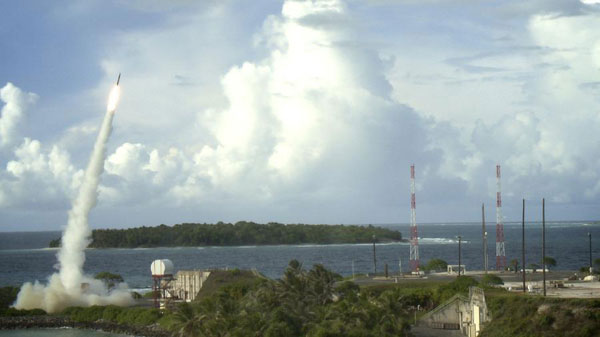
A Terminal High Altitude Area Defense (THAAD) interceptor is launched during a successful intercept test, in this undated handout photo provided by the US Department of Defense, Missile Defense Agency. [Photo/Agencies] |
The United States is busy preparing to deploy the Terminal High-Altitude Area Defense system in the Republic of Korea ignoring the strong protests by China and Russia, which justifiably say it will pose a strategic threat to their security. And the US-led NATO is consolidating its presence in Eastern Europe. What are the motives behind these chessboard moves?
At the turn of the new century, the US began its largest strategic adjustment since the end of the Cold War, shifting its strategic focus from Europe and the Atlantic to the Asia-Pacific. Right after George W. Bush took office as US president, his administration made the decision to change the oversea deployment pattern of the US military, from the previous 60 percent for Europe and 40 percent for the Asia-Pacific to 50 percent each for the two regions. It also listed China as a major competitor for the first time. The Bush administration failed to make the strategic adjustment only because of the Sept 11, 2001, attacks and the "war on terror" that followed.
Ever since President Barack Obama entered the White House he has been determined to advance the "pivot to Asia" strategy to overcome the "threat" China's rise poses to the US' hegemony in the Western Pacific. The Obama administration's strategic push has continued uninterrupted despite the political turbulence in the Middle East, the Ukraine crisis and the rise of the Islamic State. NATO's eastward expansion and "pivot to Asia" both are the result of the change in the established international order and the US' altered strategic perception, and they reflect the change in its strategic focus at different times.
Some White House officials believe US-Russia relations are not parallel to US-China ties, because they view a power game between the US and Russia as one between "a superpower and a power" but find it difficult to define any game between Beijing and Washington. Given this fact, the US-led eastward expansion of NATO is secondary in importance to the "pivot to Asia" strategy. According to some in the US, the "pivot to Asia" is a strategic design relevant to the US' overall development, while the plan for Russia's containment in Europe is a kind of tactical move.
In the context of "pivot to Asia", the US has intensified its efforts to unite its allies in Asia in order to forge an Asian version of NATO.
Compared to the impact of NATO's eastward expansion on Russia, the "pivot to Asia" strategy will create more strategic pressures on China. Though China and Russia don't want a confrontation with the US and will not forge a formal alliance, they have been forced to stand closer to cope with the strategic squeeze applied by the US and its allies.
China's top strategic priority is to ease the huge security pressures and meet the challenges created by the US' strategic shift to the Asia-Pacific. Since the Asia-Pacific is a region the US will pay special attention to, it is expected to focus its energy and resources on it to check China's rise after putting continuous pressure on Russia.
To deal with the US' strategic squeeze, China and Russia should intensify their cooperation in Northeast Asia, a region easier for them to work together compared with areas like the South China Sea. As a start, they should take necessary measures to counter the threat posed by THAAD's deployment in the ROK because the Washington-Seoul move will break the delicate strategic balance on the Korean Peninsula.
Moreover, while reiterating its strong resistance to THAAD, the Democratic People's Republic of Korea should abandon its nuclear program and stop testing missiles in order to prevent the US and the ROK from using those as an excuse to expedite the deployment of THAAD.
The author is an assistant research fellow at the National Institute of International Strategy, Chinese Academy of Social Sciences.


It has been a while since I've contributed to this Forum and I figured that since now I am officially on summer holiday and another school year is behind me I would share a post with you.

Copyright 1995 - . All rights reserved. The content (including but not limited to text, photo, multimedia information, etc) published in this site belongs to China Daily Information Co (CDIC). Without written authorization from CDIC, such content shall not be republished or used in any form. Note: Browsers with 1024*768 or higher resolution are suggested for this site.
License for publishing multimedia online 0108263 Registration Number: 130349