 |
|
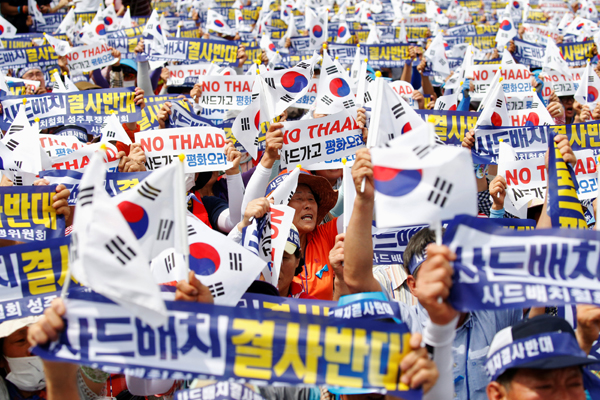
File photo shows Seoungju residents chant slogans during a protest against the government's decision on deploying a US THAAD anti-missile defense unit in Seongju, in Seoul, South Korea, July 21, 2016. The banner reads "Desperately oppose deploying THAAD". [Photo/Agencies] |
While dividing public opinion in the Republic of Korea and provoking strong opposition from neighboring countries, including China, the recent decision by the ROK to deploy the Terminal High Altitude Area Defense system on its soil has also antagonized the Democratic People's Republic of Korea.
Aside from making fierce objections to the move, the DPRK has launched medium and short-term missiles in response to the announcement. Pyongyang is likely to further escalate its military reactions to the deployment of the United States' THAAD anti-ballistic missile system in the ROK, which will further worsen the situation on the Korean Peninsula.
The reason openly cited for the deployment of THAAD in the ROK is to defend against the threats from the DPRK. However, such a pretext has essentially exposed the US' rigid policy toward regional security pressures and its passive approach to resolving the nuclear issue on the Korean Peninsula.
It is also a reflection of the US' pursuit of so-called absolute security, even if that means sacrificing the interests of its allies.
Looking at the development of the Korean nuclear issue indicates that the DPRK's nuclear and missile program is first for self-protection and then for use as a bargaining chip with the US. Pyongyang expects to end the decades-long Cold War hostility by persuading Washington to engage in talks. However, the US administration of President Barack Obama has shown no willingness to resolve the DPRK nuclear issue through talks and has instead chosen to exert increasing pressure on Pyongyang.
Aside from imposing sanctions on the DPRK via the United Nations, the Obama administration has also chosen to deepen the US' military cooperation with its Northeast Asian allies, increasing the number of joint drills and accelerating its military deployment in the region. In so doing, the US appears to be actively responding to the "security concerns" from its allies, and is presenting the image of a "responsible superpower" to audiences at home and abroad.
Washington also wants to utilize THAAD deployment to bind the ROK more tightly to the US chariot, and further advance its established "pivot to Asia-Pacific" strategy through stationing its advanced missile-intercepting system on the doorstep of China and Russia.
Deploying THAAD in the ROK will increase rather than ease the complex security issues the ROK faces. It threatens the ROK with more direct military strikes from the DPRK as a retaliatory measure. The deployment will also inevitably make the much weaker DPRK feel a more immediate security threat and then motivate it to develop more conventional and even nuclear weapons to ensure its security. Compared with the US, the ROK is an easier target for military vengeance from the DPRK.
Its deployment of THAAD will also likely lead to political instability within the ROK. The anti-missile system is mainly for the security of US military bases in the ROK, and Seoul will not be under its protective umbrella. The green light the ROK has given to the system is more out of its consideration for a closer alliance with the US. However, the move has sparked objections from many in the ROK.
The decision has also damaged the ROK's relations with neighboring countries. The anti-missile system obviously goes beyond ROK's normal self-defense needs and has thus inevitably caused grave security concerns and strong opposition from neighboring countries such as China and Russia. So, it should come as no surprise if they decide to take corresponding countermeasures.
The standoff between the US and the DPRK is the core issue on the Korean Peninsula. Its settlement will ease ongoing tensions on the peninsula and greatly improve the security situation in Northeast Asia. Only talks can break the stalemate. The vicious circle resulting from escalated military moves and countermeasures will only result in escalated military tensions.
The US should adjust its policies toward the DPRK and create a conciliatory environment for talks instead of further stoking regional tensions by escalating its military confrontation. The deployment of THAAD in the ROK will not only compromise the security of the ROK, it will also sabotage regional security, global strategic stability, and finally its own long-term strategic interests.
The author is an associate research fellow with the Institute of Strategic Studies at the National Defense University of the People's Liberation Army.

Copyright 1995 - . All rights reserved. The content (including but not limited to text, photo, multimedia information, etc) published in this site belongs to China Daily Information Co (CDIC). Without written authorization from CDIC, such content shall not be republished or used in any form. Note: Browsers with 1024*768 or higher resolution are suggested for this site.
License for publishing multimedia online 0108263 Registration Number: 130349