 |
|
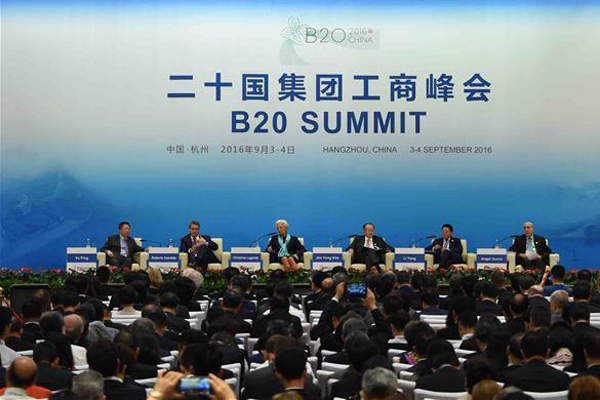
The Business 20 (B20) Summit starts in Hangzhou, capital of East China's Zhejiang Province, Sept 3, 2016. [Photo/Xinhua] |
President Xi Jinping made a crucial point at the Business 20 Summit on Saturday, when he said that China, as a beneficiary of the current international order, does not seek to rewrite the international rulebooks. Instead, it wants to refine the existing mechanisms to facilitate global win-win cooperation.
His appeal for multilateralism in global governance explains why Beijing holds the G20 so dear.
Some people tend to read Beijing's enthusiasm as eagerness for securing its footing on the world stage, or an opportunity to announce its coming of age as a global power.
Beijing never conceals its desire for a greater say in global governance-and there are plenty of China-related misgivings that Beijing can dispel. But, more importantly, it boils down to its belief that it is imperative to invigorate the global economy.
Compared with some countries' opportunist approach to the international forum, China instead appreciates the power of synergy in global economic governance.
The G20 is thus regarded as a more fitting forum for international economic discourse than the G7 and United Nations, because the former is too exclusive and unrepresentative of the broader world, and the latter too broad and often unproductive for handling the world's economic woes.
One goal of the Hangzhou Summit, according to Xi, is to shift the G20's focus from crisis response to long-term governance.
As this meeting is taking place amid a resurgence of trade and investment protectionism, many doubt the group's ability to produce breakthroughs or collective policies at this session of the world's leading developed and developing economies.
Such concerns only make Beijing's proposals, centered on an open and inclusive "new type of world economy", more valuable for serious deliberation by all parties. Because the disarray of the global economic landscape, with each country going its own way or even resorting to beggar-thy-neighbor approaches, has announced the failure of unilateralism.
As an old Chinese saying goes, "to cure a disease, one should treat its root causes; to fix a problem, one should target its source".
Beside the global economy's waning growth momentum and diminishing potential, the problem of uneven development is far from being resolved, and the inadequacies of the existing economic governance mechanisms and structures have become increasingly evident.
Xi urged the G20 leaders to prescribe remedies for the sluggish world economy to embark on a road of robust, sustainable, balanced and inclusive growth while addressing the opening of the G20 Summit on Sunday.
His proposals ranged from strengthening coordination in macroeconomic policies, innovating growth patterns, improving global economic governance, and furthering the liberalization and facilitation of trade and investment, to promoting inclusive growth.
Beijing's prescriptions may sound too good to be executable at this point, but not if the G20 members, as Xi called for, "work with real action with no empty talk".
By formally announcing their commitment to joining last year's Paris Agreement on climate change right before the summit, Beijing and Washington demonstrated what Xi described as "shared ambition and resolve" to address global issues. With China and the US "leading by example", as US President Barack Obama put it, rhetoric about broader cooperation will be more credible than it would otherwise be, and not just in emissions control.
Any progress in that direction at the Hangzhou Summit is to be welcomed as it will help to find "a direction and a course" for a more invigorated and inclusive world economy.

Copyright 1995 - . All rights reserved. The content (including but not limited to text, photo, multimedia information, etc) published in this site belongs to China Daily Information Co (CDIC). Without written authorization from CDIC, such content shall not be republished or used in any form. Note: Browsers with 1024*768 or higher resolution are suggested for this site.
License for publishing multimedia online 0108263 Registration Number: 130349