APEC: Genuine collectivism and effective connectivity
 |
|
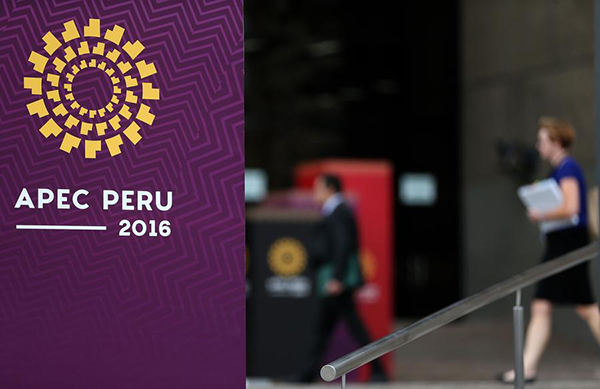
People walk outside the International Media Center (IMC) of the 2016 APEC Economic Leaders' Week in Lima, capital of Peru, on Nov 15, 2016. [Photo/Xinhua] |
On 19–20 November 2016, Lima will host regular meeting of the Asia Pacific Economic Cooperation. Leaders of 21 members will gather in order to discuss pressing global and regional economic issues and chart future tasks.
The conference will take place against the background of global political and economic turbulence. The ongoing shaping of new polycentric world order is accompanied by growing instability. There are increasing risks posed by terrorism and extremism, regional conflicts and migration crisis. "Information wars" are incited in order to undermine sovereign states. Some countries pursue the same nefarious purpose by resorting increasingly often to illegal unilateral trade and financial sanctions challenging the exclusive prerogative of the United Nations Security Council.
All of this has seriously hampered the efforts to finally overcome the crisis and get the world economy back on track towards steady and balanced growth. It has affected investment, global GDP growth rate and international trade.
In the Asia Pacific, the effects of these negative tendencies have been mitigated by major technological and financial potential that has enabled the region to maintain its leading positions in world affairs. However, it is evident that the growing challenges will undoubtedly have a negative impact on the prospects of long-term growth in the region.
As a Eurasian power and an inalienable part of the Asia-Pacific region in terms of geography, history, politics, and economy, Russia is interested in ensuring peace, stability and prosperity in the entire region. Constructive involvement in the system of dynamic economic links therein is an objective prerequisite to successful fulfillment of our own tasks, particularly those of accelerated development of the Russian Far East, including via participation in regional integration processes.
We are convinced that the only possible way to create a favourable environment for sustainable progress in today's increasingly interconnected world is through cooperation with obligatory regard for the interests of all countries. This is true of both politics and economy.
In politics and security, we stand for tackling this task through collective development of a code of mutually acceptable conduct based on the principle of equal and indivisible security. Judging by the support from a growing number of partners, the need for this approach is on the rise.
The current situation urges us to apply this principle to social and economic development as well, all the more if the regional economies genuinely want to make it inclusive. We are pleased to note that the idea is gaining supporters in the APEC platform, as it naturally complements the principles of consensus and voluntariness that are fundamental for the Forum.
Lack of progress in the Doha Round of multilateral trade negotiations is undoubtedly a contributing factor in the current instability of the global economy. That inflicts a shift in focus from global governance to regional trade mechanisms that in certain cases involve regulation aspects that exceed by far the World Trade Organisation agenda. Thereby, the role of the WTO as a unique organisation establishing and coordinating the universal rules of world trade is challenged. As a result, virtually closed areas with strict control over production chains are being created, basically for receiving maximum technological rent by a restricted number of players, which runs counter to the interests of regional and global development.
In this connection, we consider that one of the priorities of the forthcoming conference is to explicitly confirm the APEC's principal position concerning the complementary role of regional trade agreements as regards the multilateral trade system. This is the only way to ensure balanced development of the global economy, and prevent its fragmentation and destabilisation.
- Peruvian officials, residents pin high hopes on APEC meetings
- 2016 APEC Economic Leaders' Week kicks off in Lima
- Free trade still the priority for APEC
- APEC meeting vital to progress on Asia-Pacific free-trade zone, says Mexican expert
- APEC 2016: Chinese visitors to Peru rank No 1 in business, investment
- 2016 APEC Economic Leaders' Week kicks off in Peru
- Xi's attendance at APEC will promote regional economic integration: senior officials