Parents need not be pupils' homework tutors
 |
|
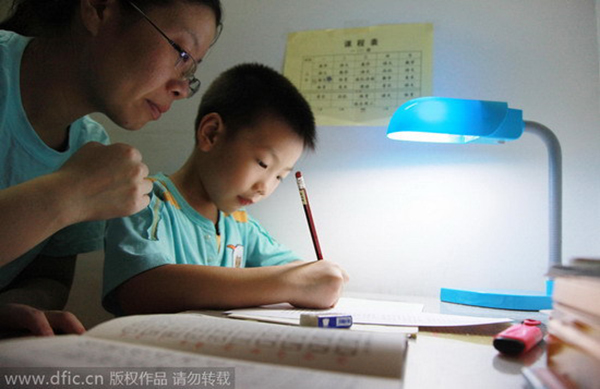
Mom helps son with his homework in Nanjing, Jiangsu province on Sept 24, 2013.[Photo/IC] |
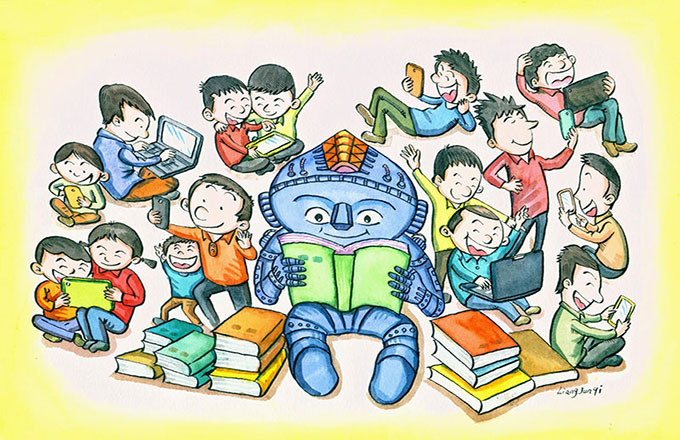
It seems to be increasingly the case that, as soon as Chinese parents return home from a hard day's work, they start working as unpaid tutors to help their children with their homework.
In education theory, there has always been a debate about "nature versus nurture". Thus the question: Can those with innate high IQ get excellent test scores despite doing little homework, or others of seemingly less natural ability can do just as well if they are provided with the right home environment in which to study more and prepare for those tests? Most educators believe parents can exert a powerful influence on their children by building a supportive home environment for doing homework.
However, this environment includes setting aside a fixed amount of time for children to do their homework, free of distractions, in a quiet room. Good reference books and perhaps the latest technology can all help, as can parents' encouraging attitude to doing homework, a strong interest in the results and even some incentive of a reward for getting good results. None of this, though, implies that parents need to act as substitute or additional tutors for their children.
The College of Education of the University of Texas at Austin, Texas, has conducted research on the subject, which suggests parents regularly helping students to do their homework, even in effect doing it for them, lead to lower achievement by their children in the long term. On the other hand, parents who focus on motivating their children to do their own homework and clearly communicate what they expect from their children to believe that they can not only overcome challenges while doing their homework, but also shoulder more responsibilities and ultimately do better in school.
So by helping their children do their homework (or doing it for them), Chinese parents are reducing their children' ability to meet the challenges on their own while imposing an extra work burden on themselves. Moreover, there is the important point of how effective a tutor a parent can be. An old saying, "I have forgotten more than you ever learned", springs to mind.
If parents feel their children need more tuition than their school can provide, and they can afford it, it makes more sense to pay for a trained tutor to help correct the children's misunderstandings and facilitate their learning process while stopping short of doing their homework.
Where does the pressure on parents to tutor their children come from? Is it because they feel school teachers are not doing a good enough job? That would be a harsh conclusion. Classes are large and teachers cannot prepare every student to be top of the class.
Educators know there is a bell curve of ability and if everyone is getting an A, then the tests are probably not good differentiators. Yet every parent wants an A for their child to clear the path for entry to the best universities and the best possible careers.
Many people believe that the Chinese society is becoming ever more competitive, that the number of students seeking entrance to universities is a couple of million more than the available seats, and that looking ahead the more than 7 million coming out of universities every year are facing tougher competition to get suitable jobs.
The irony is that making young children dependent on their parents to get their homework done, when encouraging them to be independent and meet the educational challenges on their own should be the natural choice, may make these children less competitive when they face the challenges of higher education.
The author is an economist and director of China programs at CAPA International Education, a US-UK-based organization that cooperates with Capital Normal University and East China Normal University.