Textbooks can't be the only guide for pupils
 |
|
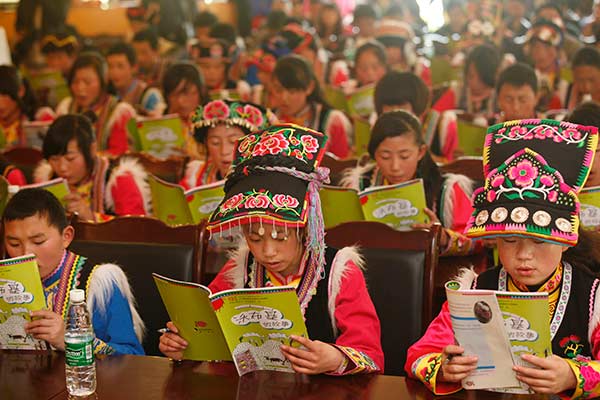
Students from the Qiang ethnic group study the regional textbook in Sichuan province.[Photo/China Daily] |
The People's Education Press has announced that it will remove the "fake text" about Thomas Edison (1847-1931) from textbooks since the next semester from September.
According to that text, Edison, as a child, used mirrors to direct light to the operation table during his mother's appendicitis surgery. Though the story highlights the earlier creativity of Edison, the first appendicitis surgery was performed in 1886, when Edison was 39 years old.
Some people said some Chinese textbooks have similar factual errors. For instance, one text describes a father rushing to a school to save students after the 1994 earthquake rocked California. Yet a simple fact check shows the 1994 earthquake occurred at 4:30 am when most of the students were in bed. All such texts sound like the story of George Washington cutting the cherry tree, teaching good moral lessons with fake stories, which eventually lead to credibility problems. And after suspecting readers debunk such stories, editors should either correct the mistakes or remove the contents from textbooks.
But a few authorities argue that these are not history textbooks, but books to teach Chinese language and literature to students. As such, they allow room for fictional "embellishments". Such arguments are indefensible, as Edison is a historical figure and biographical materials should be faithful to facts. Authors or editors cannot just make up content with factual loopholes.
It causes a great uproar every time there is an issue with Chinese textbooks, for instance, when someone detects a problem, or when editors remove a historically revered author's article. One wonders why such debates don't stay in the smaller circles of Chinese teachers and textbook compilers. The main reason is that the teaching of language and literature revolves excessively around the use of a few textbooks students are assigned, even when there are more and better reading materials out there.
In urban areas with ample number of bookstores and libraries, students have access to other books they can read, which could mitigate the problems caused by these "fake texts". But in rural and less-developed areas, students don't have facilities or resources to borrow or buy additional books. Their textbooks become the only books they read, hence their importance and the public attention on them.
I have also noticed that none of the textbook controversies in the past decade was identified by a student suspecting an error. It is worrisome that the majority of students just accept whatever they get.
Heavy dependence on textbooks in China might cause "intellectual malnutrition" among students. It's true that editors carefully select these textbooks, but students should also be taught to find additional reading materials to enrich themselves. Educators and families should not put all their developmental eggs in one textbook basket for students. While publishers should address the problems with textbooks, I have higher hope that teachers and parents would scaffold students' ability to choose additional sources to read. I also plead for more reading, as a thin textbook doesn't offer much for the developmental needs at any grade level.
To widen students' scope of reading, the Chinese government ought to build libraries in less-developed areas. With ubiquitous technology and mobile phone access, Chinese educators should also think of innovative solutions to help students overcome the problems with accessing high-quality reading materials.
Mobile reading is becoming increasingly available for the average Chinese reader, and plenty of reading materials have already been digitized. The scarcity of content or platforms should no longer be a problem. What follows then is the development of teachers' ability to help students screen and select a vast array of reading materials.
Besides, increased need for reading should be an opportunity for textbook publishers, too, as they can offer more products to teachers and parents to choose from.
Berlin Fang is an instructional designer, literary translator and columnist writing on cross-cultural issues.