China defines new globalization with its characteristics
 |
|
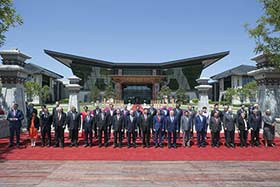
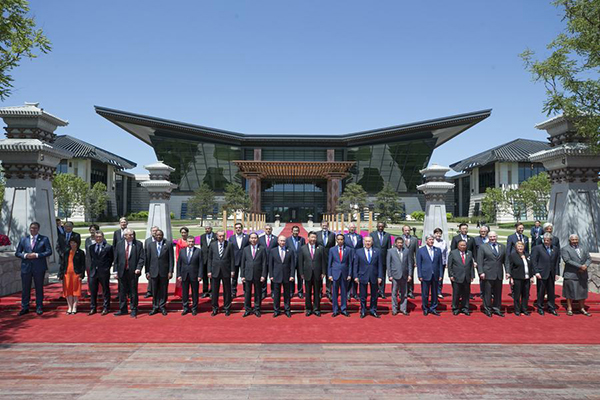
President Xi Jinping, foreign delegation heads and guests pose for a group photo at the Leaders' Roundtable Summit of the Belt and Road Forum for International Cooperation at Yanqi Lake International Convention Center in Beijing, May 15, 2017. [Photo/Xinhua] |
When I first coined the term "Chiglobalization" in 2009, it was a visionary concept inspired by Niall Ferguson's concepts of UK-led Anglobalization and US-led Ameriglobalization along with the successful 2008 Beijing Olympic Games. Eight years later, the concept of China-initiated globalization is materializing, and the definition is more valid and reliable than before.
The concept captures exactly what China's leadership has been doing since 2013, particularly with the vision of Chinese dream and the Belt and Road Initiative President Xi Jinping proposed.
Back then, I defined Chiglobalization as "the increasing global relevance, global presence, global influence, and global leadership of China in generating a fresh global vision for humanity, in creating a new model for economic development, in forging an alternative model of global and domestic governance, in creating a new model for science and technology development, and in creating a truly cosmopolitan culture characterized by multiculturalism, interculturalism and pragmatism."
Chiglobalziation also suggested that it "refers to a process of China-led global search for and a global enlightenment by an alternative mode of life for humanity on the basis of, but above and beyond, the Eurocentric model," or the Anglo/American-centric model, for that matter.
Consumer goods exported to all over the world helped deepen China's global relevance and defined her global presence as a world factory after the country joined the World Trade Organization in 2001. More than 500 Confucius Institutes and 1000 Confucius Classrooms spread out among some 130 countries/regions put "Cultural China" on the world stage engaging in face-to-face dialogue with the world.
China's initial effort to exercise global influence is subsequently solidified by the recent exponential growth of her outbound economic clout. China is conservatively reported as the world's second largest economy. With $4 trillion of foreign currency savings and domestic savings of 155 trillion yuan, equivalent of more than $22 trillion, China has been feverishly seeking in recent years to buy up properties and invest for corporate mergers and acquisitions around the world.
With a total of $1 trillion FDI, China has directly invested more than $150 billion around the world, second only to the US and around 10 percent of the total global FDI amount in 2015 alone. This is coupled with growing numbers of outgoing Chinese tourists who spend $1 trillion on their foreign tours around the world.
Take China's influence in the US, for example. While Chimerica was coined to describe the growing economic interdependence between the US and China, "Chinafornia" is used to illustrate this roaring dynamism: As an epicenter of the national trend, "Chinafornia is the fluid ecosystem of entrepreneurs, students, investors, immigrants, and ideas bouncing back and forth between the Golden State and the Middle Kingdom."
Moreover, discussions between the US and China are reportedly underway for China to invest in President Donald Trump's $1 trillion plans for infrastructure improvements across the country, likely part of China's Belt and Road Initiative. China's power in national defense, global influence and the cultural industry is narrowing the gap with the US. Yanzhong Huang, a fellow on the Council of Foreign Relations, concludes that China is a superpower, but not yet a global leader.
Perhaps it's more accurate to say that China is on the path towards global leadership. Belt and Road Initiative, proposed by Chinese President Xi Jinping in 2013, is a plan to invest $1 trillion as seed money and attract an additional $9 trillion for infrastructure construction around the world, particularly Asia. This can be interpreted as a game-changing exercise of China's global leadership, riding on a new wave of globalization with an aim of engineering better global governance. President Xi expressed such aspirations in keynote addresses at the World Economic Forum in Davos and at Europe's UN Headquarters in Geneva.
China has a core strategy. Instead of building military bases around the world like the US, China is relying on comprehensive strategies of communication and connectivity ranging from politics to finance, from infrastructure and trade to culture and religion to construct zones of economic cooperation and centers of cultural exchanges.
President Xi and President Trump may have ironed out an elite international design to facilitate dialogue and negotiations over US-China relations, the Asia-Pacific and global affairs at the Mar-a-Lago Resort in April, and the Belt & Road Forum might be viewed as more of a mid-level design to establish a global dialogical structure with middle and small powers for co-development and co-security. Such a two-tiered structure is indicative of and facilitates formation of a new global culture – a world community of a shared future.
Based upon the strengths of its predecessors such as the neoliberal world order, Chiglobalization could define and sustain a new wave of globalization and global governance with the Chinese accent in the 21st century as more benign, both more equal and equitable, more open and pluralistic, more peaceful and harmonious than its predecessors.
Given China's core value of groupism, Chiglobalization coincides with multilateralism, a kind of co-globalization, and even Chiglocalization – encompassing re-modernization and re-globalization in the form of infrastructure improvements for developed countries and brand-new modernization for developing countries.
Globalization has no endpoint and it cannot afford homogeneity either. Chiglobalization, like its predecessors, is making the phenomenon full, less partial and homogenous, and more diverse. Every nation should have a chance to ride this new wave of globalization.
Western leaders, including former President Barack Obama, and mainstream American media have criticized China for being a free rider in global governance. But now China is taking up the Belt and Road initiative, a new global public good to sustain globalization and global governance.
The Western world, particularly the United States, should have welcomed this initiative. In the meantime, China learned a lesson from the negative experience of rejecting Anglobalization and Ameriglobalization and the positive experience of embracing them later on.
The author is a professor with the School of Communication, Chapman University and a fellow with the National Academy for Development & Strategy, Renmin University of China.
The article was first published on Yale Global Online on June 6, 2017. The opinions expressed here are those of the writer and don't represent views of China Daily website.