Expansion to add fresh vitality to SCO
 |
|
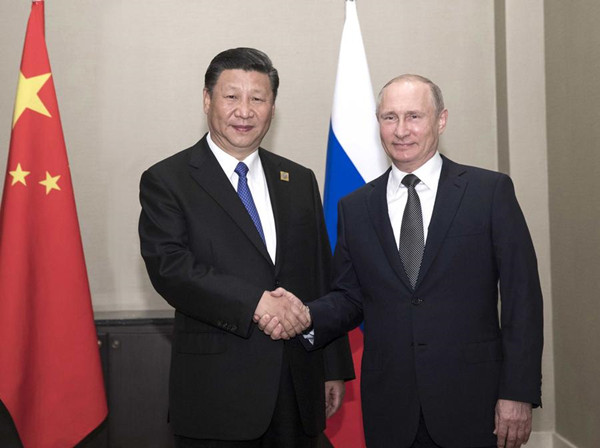
Chinese President Xi Jinping shakes hands with Russian President Vladimir Putin during their meeting as part of the Shanghai Cooperation Organization (SCO) summit in Astana, Kazakhstan, June 8, 2017. [Photo/Xinhua] |
This year marks the 15th anniversary of the SCO Charter and the 10th anniversary of the Treaty on Long-Term Good-Neighborliness, Friendship and Cooperation of the SCO Member States. That China has developed a comprehensive strategic partnership with many Central Asian countries is proof of the vitality of the bloc, which has just entered its 16th year.
The SCO has accorded priority to unity in the first decade of its existence, but now it also needs fresh vitality to intensify multilateral operations and more efficiently implement its plans. In this sense, the accession procedures for India and Pakistan, which started in 2015 at the Ufa summit in Russia, are not just about institutional expansion or revision but also improvement.
On their part, New Delhi and Islamabad have completed all the procedures to obtain the full SCO membership. As have the SCO members which signed a memorandum on the obligations of the two new entrants at the 2016 Tashkent summit in Uzbekistan.
The inclusion of India and Pakistan means the bloc will account for 25 percent of global GDP compared with 15 percent in the past, cover 44 percent of the world population, and expand its geographical reach to South Asia. Covering about three-fifths of Eurasia, the SCO will play a bigger role in safeguarding regional stability and optimizing the world order.
The two South Asian neighbors' accession to the security-oriented SCO could also help them improve their bilateral ties. Both countries attach great importance to trade with Central Asia, China and Russia. And as one of the world's largest energy consumers, India would like to step up its energy cooperation with resource-rich Russia and Central Asian states and contribute to the integration between the SCO and the South Asian Association for Regional Cooperation.
The expansion will also give the SCO a bigger say in international affairs, by rallying more concerted efforts to combat the "three evil forces" of terrorism, separatism and extremism, as well as other cross-border crimes, such as money laundering and drug trafficking.
The implementation of the security agreements under the SCO framework such as the anti-extremism convention will not just put the Belt and Road projects under greater protection, but also provide a platform for dialogue for member states that have border disputes.
Since the SCO's expansion is not only about extending the bloc's geopolitical reach or focusing on the Central Asian affairs, the decision to include India and Pakistan must have been made against the backdrop of increasing sectarian clashes and the rise of anti-globalization in many parts of the world. It could bring about challenges, too, as SCO members, most of which are developing and emerging economies, may have different understandings of future coordination. However, the Belt and Road Initiative should be able to help them in upgrading their industrial capacities and facilities while making the most of technological innovation.
The author is secretary-general of the Shanghai Cooperation Organization Studies Center at Shanghai Academy of Social Sciences.
- Xi returns after visit to Kazakhstan, SCO summit
- Chinese president's speech at SCO summit praised by overseas experts, scholars
- SCO expansion vital for int'l security, common prosperity
- Belt & Road Initiative enhance trade, investment in SCO countries: Chinese Minister of Commerce
- Xi's Kazakhstan trip cements broader B&R, SCO cooperation