Comments()
  Print
Print  Mail
Mail  Large Medium Small
 |
|
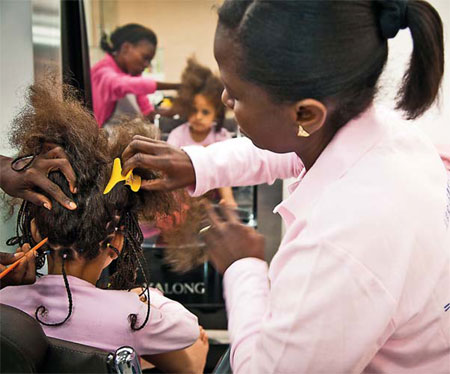
Above and below: Congolese fashion designer and hairstylist Martha Makuena is busy working at her hair salon in Beijing. Photos by Cao Huan / China Daily |
 |
|
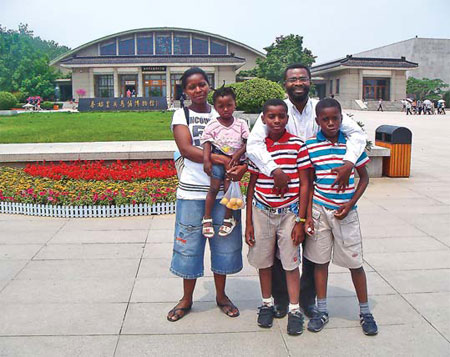
Martha Makuena, Paul Luyeye and their three children visit Xi'an, Shaanxi province. Provided to China Daily |
My China dream | Martha Makuena
China is indeed a land of opportunity, as Martha Makuena found out when she opened a hair salon for people of African origin, and she's now more comfortable here than at home. She shares her story with Yang Guang.
 |
When Martha Makuena from the Congo first arrived in China, she was bored and listless. In 1999, her husband Paul Luyeye arrived in Wuhan to work, and she had followed him. In their community, they were the only foreigners, and Makuena spoke no Chinese and had no friends.
At the time, the Chinese made a clear distinction between laonei (Chinese) and laowai (foreigners), says Makuena, a fashion designer and hairstylist by training in her hometown Kinshasa.
"I felt completely like a laowai," the mother of three recalls.
Her two sons and a daughter were all born here. She certainly did not expect that, 13 years later, she would be the proud proprietor of a hair salon in Beijing that caters to people of African origin.
The shop in the Central Business District is the only of its kind in Beijing.
The road to success was long and hard. In 2003, Makuena had moved to Beijing with her husband and children because Luyeye changed jobs. To keep herself occupied, Makuena finished a year of studying Chinese and took another two years to finish a bachelor's degree in business administration.
She was surfing an online expatriate community chatroom when she saw an African woman asking about where to do her hair.
"African hair culture is a personal issue with a long and complex history," Makuena explains.
"I would say it is difficult for a Chinese hairdresser to meet the needs of an African or person of African descent insofar as hair is concerned."
For instance, haircare products used by Africans, such as creams, oils and other kinds of treatment are different from those used by other people.
Makuena responded to that online request and was soon providing hairstyling services from home. Her customers quickly increased through word of mouth, and the group grew larger and larger.
When the family moved again to Suzhou in Jiangsu province in 2010 because of yet another job relocation, many of Makuena's customers followed. They came from Shanghai and Nanjing, and one even flew in from Chongqing.
Makuena has seen the size of the African community in China grow during her years in China, and she figures there are about 3,000 in Beijing alone.
That was the business opportunity, and Makuena and Luyeye started preparing for her hair salon in September last year.
"It was not that easy," says Luyeye says.
"It was as hard as any startup company in China. If it was easy, everyone would do it."
Makuena went back to Kinshasa to recruit local hairdressers, and the salon opened its doors at the end of April this year.
Briton Nicola Thompson has been a loyal customer since she first knew Makuena from a friend four years ago. The 29-year-old teacher with an international school in Beijing says she trusts Makuena so much that she will not have her hair cut by anyone else.
"I kept asking when her salon would open, and finally it is here," Thompson says.
Prices for different services range from 40 yuan ($6.28) to 1,000 yuan. One of the most expensive services is for micro braids, which take at least eight hours to finish. For this, customers must go to the salon before 10:30 am.
Makuena's salon also attracts some Chinese customers.
Liu Rui, a Chinese sophomore at the Central Academy of Drama, had Makuena do his hair the African way because he says that suits his image as a part-time hip-hop singer.
Makuena now stays in Beijing to take care of her business while her husband and three children live in Suzhou. But she may get nearer to them soon, with her plans to start branches in Shanghai within this year and another in Guangzhou next year.
Having worked in the Congo, France and Canada, Luyeye says he feels there is no other country in the world that offers more opportunities than China. He adjusted easily to life here, following a piece of advice from his late father.
"Before my father died, he told me: 'My son, if you arrive at a place where you see everyone dancing with their left leg, you do the same thing. Don't think because you are special, you want to dance with the right leg.' I have always kept that in mind," he says.
That is probably why Luyeye makes it a house rule that the family must speak Chinese at home.
These days, Makuena's Chinese language skills have improved tremendously, along with her appetite for Chinese food.
The last time she went home to the Congo, she was excited to see a table of African dishes. But after a few bites, she did not want to eat anymore.
"It wasn't until I feasted at a Chinese restaurant that I realized I had finally found the food that belongs to me," she says.
"My family members joke that I had changed colors in my heart."
Contact the writer at yangguang@chinadaily.com.cn.
 Massacre victims remembered at Nanjing vigil
 Snow to hit Central, East China
 Baby red pandas survive in C China zoo
 Beijing covered in snow
 Supermarket of the future opens in E China
 12/12/12 sparks surge in marriage
 Chinese tourists welcomed to spend Christmas in Finland
 Mom helps son with learning disability
Copyright 1995 - 2010 . All rights reserved. The content (including but not limited to text, photo, multimedia information, etc) published in this site belongs to China Daily Information Co (CDIC). Without written authorization from CDIC, such content shall not be republished or used in any form. Note: Browsers with 1024*768 or higher resolution are suggested for this site.
License for publishing multimedia online 0108263 Registration Number: 20100000002731