Artificial leg, but natural talent
Updated: 2011-10-07 08:55
By Tang Yue (China Daily)
|
|||||||||||


|
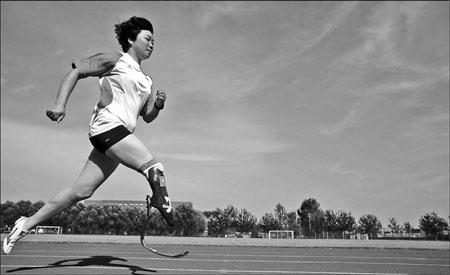
China's Wang Juan in a training session with her artificial leg in Beijing. Wang, a four-time Paralympic medalist, says her prosthesis was hard to adapt to. "My arms were bleeding almost every day," she said. [Photo by Wang Jing / China Daily] |
The Cheetah has given amputees like Oscar Pistroius a new lease on their athletic lives, Tang Yue writes
First, Oscar Pistorius had his legs amputated below the knees. Then, he learned to run anyway. Really fast, in fact. Finally, inexplicably, he had to convince people that having your legs amputated does not make you run faster.
And with all that behind him at the recently concluded World Athletics Championships, he competed against some of the best 400m sprinters in the world, and beat most of them.
Pistorius advanced to the final 16 in the individual event, and became the first amputee to win an able-bodied world track medal, joining South Africa's silver medal relay team.
Sure, it was a boost of confidence for him as he looks to next summer's Olympics in London.
But it was also a shot in the arm for the world's Paralympic athletes, many of whom use the same artificial limbs as Pistorius.
"I watched the competition - it was really inspiring news for all athletes with disabilities. It just told the world what we are capable of," said Wang Juan, a Chinese four-time Paralympics medalist who, like Pistorius, runs on the Cheetah, a flex-foot carbon fiber transtibial artificial limb produced by Ossur.
"I think his idea is very simple. He just wants to show we can also achieve what the able-bodied can, and I think he has proved it with his performance. I'm so proud of him," Wang told China Daily.
Cheetah's users seem to have mixed feelings towards the new technology.
On one hand, they appreciate that it can help them compete.
On the other, there's a nagging worry that it steals the show.
"I just hope people will pay more attention to how much effort Oscar makes in the training and competition," Wang said. "It is his pursuit of excellence and the way he challenges himself that really define him as a great athlete."
Along with attention and opportunity, the Cheetah brought Pistorius controversy and, for awhile, a ban from track.
He took part in his first international competitions for able-bodied athletes in 2007. His success was met with claims that the prosthesis gave him an unfair edge.
On Jan 14, 2008, the International Association of Athletics Federations (IAAF) ruled him ineligible for competitions conducted under its rules.
It reversed itself four months later, saying there was no evidence Pistorius had any net advantage over able-bodied athletes.
With his 400m time of 45.07 on July 19, 2011, he achieved an "A" qualifying standard for the World Championships and next year's Olympics.
Sarah Reinertsen, an above-the-knee amputee and record holder in the 200m and 400m sprint in her category and world Paratriathlon champion, said it is unfair to claim any advantage for him, labeling it "ablism" to exclude him.
"I feel for him, because he is being criticized, but it is not only about the feet. If it was only about the feet, we would have all gone to the Olympics," Reinertsen, 36, said.
"In my view, Oscar is a very fine engine, running the legs. The feet are just like the bicycles in triathlon - it is the triathletes that are running the bikes. You can't say you have such a bike and it's not fair.
"I think Oscar is facing an uphill battle. Just like they didn't want black people in the Olympics, and they didn't want women in sports. He is facing the similar kind of, you know, they use the word racism, I call it ablism."
Ossur's experts say there's scientific evidence to back that up.
A non-mechanized prosthetic running foot, Cheetah does return a portion of the energy stored during the loading phase of running.
However, studies have shown that Cheetah can return around 90 percent of the energy stored in it, which is far less than a normal able-bodied foot and leg, which can return 249% of the stored energy, according to Claudia Doebrich, Technical Manager of Ossur China.
"Another aspect is energy consumption - a lot of studies show that all amputees use more energy to walk than able-bodied people. So if you use more energy, then obviously you get more tired," said Doebrich, who has worked in clinical, lecturing and managerial positions in the prosthetic field in Australia, New Zealand and Cambodia since 1987.
"Also, you don't have sensation at the end of it (prosthesis). So it's hard to control and make everything goes exactly as you want. We do a lot of things automatically without even thinking about it, but amputees actually have to think about it to make sure that they can control it. It takes a lot of practice, a lot of running and trying out in training."
Wang knows exactly how hard it is to master Cheetah.
Wang began using the Cheetah as her right lower leg in 1999, and said the advanced prosthesis helped her improve her personal best time - but it only came after lots of tumbles and lots of bruises.
With the aid of the Cheetah and endless effort, her best result for the 100m sprint went from 14.97 sec to 13.74 sec. She also changed her take-off foot to the artificial limb in the long jump, which led to a 50cm improvement.
"But it didn't came easily at all," she said. "It was really hard to keep my balance at first, and I can't remember how many times I have fallen down. My arms were bleeding almost every day that summer."
While the Paralympics started in the 1960s, it was more than 20 years before athletes with disabilities started to train and compete with prosthesis specifically designed for sports.
Inspired by the C-shape of a cheetah's hind leg, American Van Phillips, an amputee himself, developed the initial design and began building a prototype, which finally resulted in him founding Flex-Foot, Inc. in 1984. In 2000, he sold his interest in Flex-Foot to Ossur, an Icelandic prosthetics firm that continues to build on the line. Some variation of the original design is used by some 90 percent of Paralympics athletes on the world stage.
- Two Chinese sailors still missing: FM
- Purchase of bank shares helps market
- China warns US against yuan bill
- Letter calls Gucci stores 'sweatshops'
- Fugitive boss back to Wenzhou for restructuring
- Putin visit a herald of closer ties
- WWF seeks avid bloggers to watch wild panda
- Wal-Mart stores shut for pork scandal




Hot Topics
Libya conflict, Gaddafi, Oil spill, Palace Museum scandal, Inflation, Japan's new PM, Trapped miners, Mooncake tax, Weekly photos, Hurricane Irene
Editor's Picks

|

|

|
|

|

|