Confidence in dollar sags in wake of Fed rate cut
Updated: 2007-09-24 09:51
WASHINGTON - The dollar's weakness and the euro's rise to record highs have raised questions about confidence in the US currency following a surprising Federal Reserve half-point rate cut, analysts say.
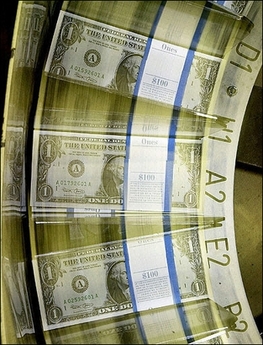 Bundles of US dollar bills are moved through the wrapping machine at the Bureau of Engraving and Printing in Washington, DC. [AFP]
|
Some are concerned that the dollar's woes may prompt central banks to cash in their greenbacks, provoking a further downward spiral for the world's largest reserve currency.
The Fed's surprisingly large half-point cut in the federal funds rate to 4.75 percent Tuesday prompted some expected selling of the dollar. But it also caused unexpected weakness on the bond market by heightening fears about inflation. Gold meanwhile surged in another sign of concern about the US currency.
The euro has moved above 1.40 dollars for the first time and some analysts say it could go even higher. The greenback has fared somewhat better against the yen because of uncertainty in Japan, and versus sterling amid banking problems in Britain. But the Canadian dollar has hit parity with the greenback for the first time in three decades.
"Some analysts thought a Fed rate cut would push the dollar up and gold down. They argued the Fed was so tight that markets were being squeezed, and this was causing demand for the dollar to fall," said Brian Wesbury, chief economist at First Trust Portfolios.
"They also argued that if the Fed cut rates, and supplied new money, the markets would unlock, demand for the dollar would rise, gold prices would fall and the dollar would rise. Oops!"
Analysts say the dollar's softness reflects a weaker outlook for the US economy and the likelihood of more rate cuts to pump up growth. Market participants expect the European Central Bank to hike rates, although some European Union officials worry the strong euro will crimp exports and economic growth.
The dollar's troubles are of particular concern in the Middle East, with many oil-exporting nations, including Saudi Arabia, that peg their currency to the greenback rethinking this strategy.
"Oil-exporting economies in the Middle East have already been struggling with an increase in inflation," said Morgan Stanley analyst Serhan Cevik.
"Even though pegged exchange-rate regimes demand to mimic the Federal Reserve's decision to cut interest rates, Gulf countries actually need a tighter policy stance to bring inflation down."
Saudi Arabia's decision not to follow the Fed rate cut on Tuesday prompted speculation that the oil-rich kingdom may either de-peg from the dollar or diversify central bank holdings.
"Rumors that the Saudi Arabian Monetary Authority (SAMA) was about to drop the peg of its currency to the US dollar triggered market reaction," said David Kotok at Cumberland Advisors.
"There are fears that this could lead to substantial sales of dollar assets. Markets worry that SAMA and other central banks have contributed to the latest dollar slide. These rumors were sparked by SAMA's failure to follow the Fed in cutting rates. But SAMA's governor has indicated that high inflation in the Kingdom was the reason rates were not reduced. The Saudi-US dollar peg remains in place."
Still, Kotok said fears about central bank liquidations are overblown. He said Kuwait's decision to de-peg from the dollar had only a modest impact.
"We consider it unlikely the Saudis would choose to move out of US dollar assets in a major way," he said. "All Saudi exports are denominated in US dollars. So are 75 percent of its imports. Their reserves continue to accumulate and must be invested in deep liquid markets."
Kotok said that any move away from the dollar is likely to be "orderly" but that the euro could go as high as 1.50 to 1.60 over the long term.
Susan Voigtsberger at PNC Bank said the dollar's woes are far from over.
"The continued dollar weakness can be attributed to the liquidation of dollar positions by foreign investors, including central banks," she said.
"These entities have enjoyed the benefits they were getting from surging Treasury prices over the past couple of months, but the decline of the dollar is making these investments into a net loss."
"The dollar weakness is causing loss of confidence in the US dollar as a reserve currency," Voigtsberger added.
|
|
|
||
|
||
|
|
|
|