Wall Street extends plunge; Dow down 306
Updated: 2008-01-18 08:07
NEW YORK - Wall Street extended its 2008 plunge Thursday, tumbling after a regional Federal Reserve report showed a sharp decline in manufacturing activity and as investors feared that downgrades of key bond insurers could trigger further trouble with souring debt.
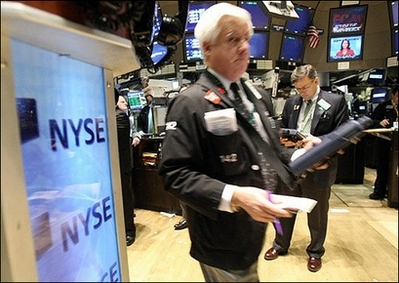 Traders watch the morning board on the New York Stock Exchange trading floor, 08 January 2007. Nerves on Wall Street are being frayed by high volatility as investors face the possibility of a US recession that could mean a bear market, or for some, a buying opportunity. [Agencies] |
The Dow Jones industrial average lost more than 300 points, or nearly 2.5 percent, giving the index its lowest close since March and its worst three-day percentage decline since October 2002. The Standard & Poor's 500, the index closely watched by market professionals, fell nearly 3 percent Thursday.
Stocks opened higher but quickly gave up their gains after the Philadelphia Federal Reserve said its survey of regional manufacturing activity registered a negative 20.9 from a revised reading of negative 1.6 in December. The latest number came in well short of what Wall Street had been expecting and underscored the seriousness of the economic worries that have gripped both Wall Street and Washington in recent weeks.
Credit concerns also dogged Wall Street after rating agency Moody's Investors Service placed bond insurer Ambac Assurance Corp. on review for a possible downgrade. That possibility alarmed investors because it would place all bonds insured by Ambac on review as well. Wall Street are concerned that bond insurers would be unable to absorb a spike in claims.
Investors fears of a slowing economy again dominated trading.
"The Philadelphia Fed just announced dreadful numbers," said John O'Donoghue, co-head of equities at Cowen & Co. He said if you look back at Philadelphia Fed data for similar numbers, it takes you back to the 2001 to 2002 recession.
"It's not rocket science -- the economy is slowing dramatically, and it's being reflected in economic reports."
The Dow, which had been up more than 50 points early in the session, closed down 306.95, or 2.46 percent, at 12,159.21.
The Dow is now off 8.33 percent for the year; there have been just 12 trading days so far in 2008, but the index's frequent triple-digit losses have now forced it to give back its 2007 gains. The Dow had its lowest close since it ended the March 16, 2007, session at 12,110.41.
The Dow's decline also left it about 150 points above 12,000, a level it hasn't closed below since November 2006.
The broader market indicators also plummeted. The S&P 500 index lost 39.95, or 2.91 percent, closing at 1,333.25, and leaving it was a year-to-date loss of 9.2 percent, while the Nasdaq dropped 47.69, or 1.99 percent, to 2,346.90, giving it a 2008 deficit of 11.51 percent.
Thursday brought the lowest close for the S&P 500 since October 2006 and the worst for the Nasdaq since March of last year, and both indexes have also forfeited all of their 2007 gains.
Declining issues outnumbered advancers by more than 5 to 1 on the New York Stock Exchange, where volume came to a heavy 2.17 billion shares compared with 2.11 billion traded Wednesday.
Bond prices rose as stocks fell and anxious investors sought the safety of government-issued securities. The yield on the benchmark 10-year Treasury note, which moves opposite its price, fell to 3.61 percent from 3.68 percent late Wednesday. The dollar was mixed against other major currencies.
The Chicago Board Options Exchange's volatility index, known as the VIX, and often referred to as the "fear index," jumped nearly 17 percent Thursday.
Light, sweet crude fell 71 cents to settle at $90.13 a barrel on the New York Mercantile Exchange after Bernanke's prediction of slower economic growth this year. Slowing growth could dampen demand for oil.
The Philadelphia manufacturing reading caught Wall Street by surprise -- igniting fears that the economy is slowing precipitously and that policymakers might be too late in contemplating aid.
Economists had expected the Philadelphia index would come in at a negative 1.5, according to Dow Jones Newswires. Instead, the negative 20.9 figure was the weakest since October 2001 when the economy was reeling from the shock of the Sept. 11 terror attacks.
Jim Herrick, manager of equity trading at Baird & Co., contends that the Philadelphia Fed reading and other recent negative economic reports indicate the economy is likely in a downturn.
Other economic reports added to investors' glum mood. The Commerce Department said housing starts plunged 14 percent to 1.01 million in December, marking the weakest pace of home building in more than 16 years. In addition, permits to build new homes dropped 8 percent last month to 1.07 million, the lowest level since 1993.
The week's steady flow of news, much of which has dented investor sentiment, has led to a growing chorus of calls for the Fed to cut rates. The Fed's monetary policy committee will meet Jan. 29-30 and is widely expected to lower its Fed funds target from the current 4.25 percent level. Bernanke on Thursday reiterated recent signals that the central bank will reduce rates for a fourth straight time.
Some on Wall Street have called for the Fed to intervene sooner with steep rate cuts.
The economic concerns come in a week in which some of Wall Street's biggest names have posted huge losses following bad bets on mortgage investments. Financial shares fell sharply Thursday after the reports have made clear that there is also increasing weakness in home equity and other consumer banking operations.
Merrill Lynch & Co. on Thursday posted a massive loss that underscored the depth of the economy's credit problems. The world's largest brokerage said it lost $9.91 billion in the fourth quarter, hurt by big write-downs from investments and trades battered by tight credit conditions.
John Thain, the new chief executive at Merrill, said he believes the red ink will constitute the bulk of the company's write-downs from its subprime mortgage exposure. But he would not speculate about what 2008 might hold in store in other areas. Earlier this week, Merrill secured a new round of capital infusions from foreign funds.
Merrill fell $5.64, or 10 percent, to $49.45.
Moody's announcement that it will review Ambac came after the insurer booked a $5.4 billion write-down on its credit derivative portfolio during the fourth quarter.
Ambac plunged $6.73, or 52 percent, to $6.24, while Ambac rival MBIA Inc. fell $4.18, or 31 percent, to $9.22. First Horizon National Corp. fell $2.43, or 13 percent, to $16.48 after Standard & Poor's Ratings Services lowered its rating on the bank's long-term credit.
The Russell 2000 index of smaller companies fell 19.34, or 2.76 percent, to 680.57.
Overseas, Japan's Nikkei stock average closed up 2.07 percent. Britain's FTSE 100 finished down 0.68 percent, Germany's DAX index fell 0.78 percent, and France's CAC-40 fell 1.31 percent.
|
|
|
||
|
||
|
|
|
|