Asia-Pacific
Video links Pakistan Taliban to deadly CIA bombing
(Agencies)
Updated: 2010-01-10 08:43
 |
Large Medium Small |
KABUL: In a video broadcast after his death, the Jordanian suicide bomber who killed seven CIA employees sits cross-legged on the floor next to the new chief of the Pakistani Taliban, confirming the group was behind the brazen attack in eastern Afghanistan.
|
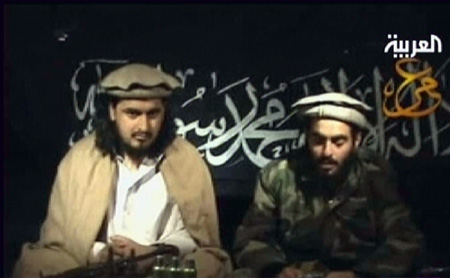 Taliban leader Hakimullah Mehsud (L) sits beside a man who is believed to be Humam Khalil Abu-Mulal Al-Balawi, the suicide bomber who killed CIA agents in Afghanistan, in this still image taken from video released Jan. 9, 2010. A Pakistan television station showed on Saturday what it said was the suicide bomber double agent who killed CIA agents in Afghanistan sitting with the Pakistani Taliban leader, and reported he shared US and Jordanian state secrets with militants. [Photo/Agencies]
|
Yet multiple insurgent groups have claimed responsibility for the bombing, and a senior Pakistani militant told The Associated Press that al-Qaida and Afghan Taliban fighters were also involved in one of the worst attacks in the US intelligence agency's history.
The suicide attack inside the CIA base could prompt the US to further pressure the government of Pakistan to crack down on militants who operate on both sides of the Afghan-Pakistan border. US missile strikes against targets on the Pakistan side already are on the rise.


The CIA had cultivated the bomber - a Jordanian doctor identified as Humam Khalil Abu-Mulal al-Balawi - in hopes of obtaining information about al-Qaida's second in command, Ayman al-Zawahri.
Defending his agents, CIA Director Leon Panetta said the bomber was about to be searched before the blast occurred.
"This was not a question of trusting a potential intelligence asset, even one who had provided information that we could verify independently. It is never that simple, and no one ignored the hazards," Panetta wrote in a Washington Post op-ed piece posted online Saturday. "The individual was about to be searched by our security officers - a distance away from other intelligence personnel - when he set off his explosives."
Al-Balawi turned out to be a double-agent - perhaps even a triple-agent. In his 1 1/2 minute video, the bomber said he attacked the CIA to avenge the death of Baitullah Mehsud, the longtime leader of the Pakistani Taliban who was killed in August in a CIA missile strike.
"This jihadi attack will be the first revenge operation against the Americans and their drone teams outside the Pakistan border," the bomber said on the video. Al-Balawi - wearing an Afghan hat and camouflaged jacket - said the Pakistani Taliban, now under the leadership of its new chief Hakimullah Mehsud, would fight till victory.
"We will never forget the blood of our emir Baitullah Mehsud," said al-Balawi. "We will always demand revenge for him inside America and outside."
Statements by Afghan Taliban and al-Qaida leaders since the attack have confused efforts to figure out which group's fingerprints were on the blast that struck a blow to the CIA's field expertise in Afghanistan.
A senior militant with the Pakistani Taliban told AP the suicide bomber received training from Qari Hussain, a leading commander of the Pakistani Taliban believed to have run suicide bombing camps. The militant, who spoke on condition of anonymity because of security reasons, said al-Qaida and the Haqqani network, a highly independent Afghan Taliban faction, also were involved.
Hussain's Lashkar-e-Janghvi group, a violent anti-Shiite Muslim organization, is believed to provide a reservoir of suicide bombers and has been linked to some of the more spectacular bombings in Pakistan and the death of former Pakistani Prime Minister Benazir Bhutto.
Arsala Rahmani - a former minister in the Taliban government that was topped in the US-led invasion of Afghanistan following the September 11 terrorist attacks - said the Pakistani and Afghan Taliban and al-Qaida often work in unison against Western forces.
"Most of the time, the Afghan Taliban, Pakistani Taliban and al-Qaida ... they are fighting together," said Rahmani.
A senior NATO intelligence official, who spoke on condition of anonymity because he wasn't authorized to release the information, said all insurgent groups have subordinated themselves to the senior Afghan Taliban leadership, believed to be based in Quetta, Pakistan.
After the attack al-Qaida's No. 3, Sheikh Mustafa Abu al-Yazid, issued a statement also saying the CIA was targeted to avenge the death of Baitullah Mehsud, as well as the killing of two al-Qaida figures - Abdullah Saeed al-Liby and Abu Saleh al-Somali.
Terrorist watchdog groups disagreed whether the message from al-Qaida claimed responsibility for the strike.
Mahmood Shah, a former security chief for Pakistan's tribal regions, said the Pakistani Taliban likely provided logistics to the bomber, but al-Qaida probably provided the recruit himself.
The CIA attack would be the most prolific strike on a US target by the Pakistani Taliban under the 20-something Hakimullah Mehsud's watch. It is also unusual because the Pakistani Taliban rarely claim responsibility for strikes in Afghanistan.
A major Pakistani army offensive in its South Waziristan tribal region is believed to have forced many Pakistani Taliban leaders to go on the run to other parts of the lawless tribal belt along the Afghan border. Hakimullah Mehsud, for instance, is believed to be evading the Pakistani military offensive by hiding somewhere along the border dividing South and North Waziristan tribal regions.
Though the group initially appeared to be in disarray after the August missile strike and the offensive, it and linked militant groups are suspected in a rising tide of violence in Pakistan. More than 600 people have died in a range of suicide and other bombings across the nuclear-armed country since October.
The release of the al-Balawi footage gives the US proof that Pakistani elements are involved in attacks on its security apparatus in Afghanistan, observers said. Already since the CIA attack, the US has accelerated its use of drone-fired missiles to take out militant targets in Pakistan's tribal regions.
At least six such strikes have hit North Waziristan, where the Haqqanis have strongholds, in recent days, including two missiles fired into a home Saturday in Data Khel that killed two people and wounded three others, two Pakistani intelligence officials said.