China, India can look beyond differences for mutual benefits
Updated: 2014-09-17 14:25
(Xinhua)
Comments Print Mail Large Medium Small
|
Backgrounder: Major events about China-India relations On July 14, 2014, Chinese President Xi Jinping met with India's new Prime Minister Narendra Modi for the first time during the BRICS Summit in Brazil. "Joining hands for peaceful, cooperative and inclusive development to enable the 2.5 billion people in both countries to live a better life, and to promote the peace and development in the region and the world, are our biggest common interests," Xi told Modi. In March 2013, Xi met with then Indian Prime Minister Manmohan Singh during the BRICS Summit in South Africa. On May 18, Premier Li Keqiang made his first foreign visit to India to stimulate economic relations and increase diplomatic cooperation. In 2012, then Chinese President Hu Jintao told Singh during their meeting at the 2012 BRICS summit that "it is China's unswerving policy to develop Sino-Indian friendship, deepen strategic cooperation and seek common development" and that "China hopes to see a peaceful, prosperous and continually developing India and is committed to building a more dynamic China-India relationship". Then Premier Wen Jiabao also had a bilateral meeting with Singh during the UN conference on sustainable development. In December 2010, then Premier Wen Jiabao paid an official visit to India at the invitation of then Prime Minister Singh. The two sides issued the Joint Communiqué Between the People's Republic of China and the Republic of India during Wen's visit. In December 2006, then President Hu Jintao made a state visit to India where he noted that bilateral relations had maintained sound momentum in recent years and the two sides had enjoyed good co-ordination in international and regional affairs. In April 2005, China and India announced the establishment of their strategic partnership for peace and prosperity in a joint statement signed by Wen and Singh. |
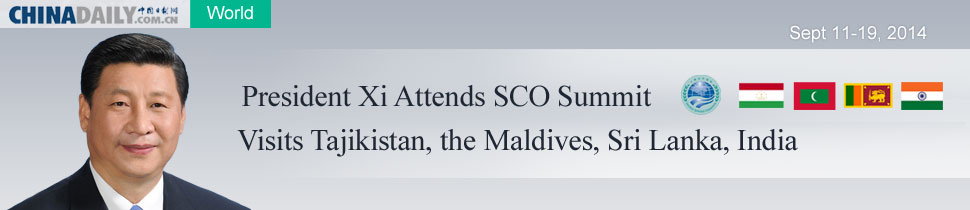
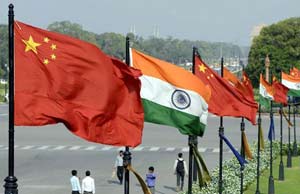
BEIJING - President Xi Jinping is due to arrive in New Delhi on Wednesday for a state visit to India, one of China's most important neighbors.
As the world's two largest developing countries, both China and India have long recognized the strategic importance of their bilateral ties and have made great efforts to ensure their overall cooperation would not be derailed by the long-existing border disputes.
The past year witnessed the most frequent high-level exchanges between Beijing and New Delhi in nearly 60 years. Premier Li Keqiang visited India in May 2013, the first leg of Li's maiden overseas trip since taking office, a testimony of China's intention to enhance ties with India.
It is a shared recognition that mutual benefits and common development can only be achieved through trust building, rather than rivalry.
Apart from their closer political relations, China and India, as the world's two largest emerging economies, also share strong economic ties.
China is India's largest trading partner, while India is China's biggest in South Asia, with the two-way trade reaching $65.4 billion in 2013.
Hailed as the world's factory and global service provider respectively, China and India enjoy great economic potential for cooperation in investment, financial services and high technologies.
Both being members of the BRICS, China and India can cooperate and coordinate closely within regional frameworks to accelerate economic development and improve the lives of their people.
The development of China and India are each other's opportunity and peaceful, cooperative and inclusive development will not only benefit the two peoples but also Asia and the world at large.
On the world stage, China and India are natural partners in setting global rules on climate change, reshaping global economic landscape and securing more rights for developing countries.
Joint efforts have been made by the two countries under multilateral frameworks, including the Group of 20, BRICS and the Doha round of global trade talks, to push for a fair and just world order.
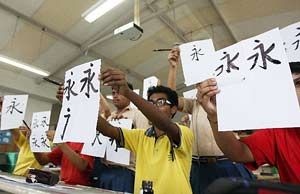
On cultural exchanges, being ancient civilizations at similar development stages, China and India have strengthened people-to-people exchanges in recent years.
As the world's most populous nations, which account for nearly 40 percent of the global population, Beijing and New Delhi are both pursuing the great dream of national renewal, dreams that are interconnected and mutually compatible.
To ensure a peaceful environment for more than 2.5 billion people combined, China and India should strive for an early and peaceful resolution to the border disputes.
It serves the interests of both sides, the whole Asia and the world at large that China and India can put aside their differences and make sure such thorny issues do not damage their overall friendly ties or derail their promising cooperation.
|
 |
 |
Related Stories
India prepares for President Xi's visit 2014-09-17 11:38
Will China-India ties take 'orbital jump'? 2014-09-17 07:50
Backgrounder: Major events about China-India relations 2014-09-16 15:50
Japan ignoring China for India is bad strategy 2014-09-11 13:57
FM: China not seeking to contain India 2014-09-10 13:24
Envoy smooths way for Xi's India trip 2014-09-10 08:16
India looking forward to Xi's visit 2014-08-28 11:29
Prospects for China-India Economic and Trade Cooperation 2014-08-27 16:38
China, India ties shift to high gear 2014-08-06 07:03
Big Talk