 |
|
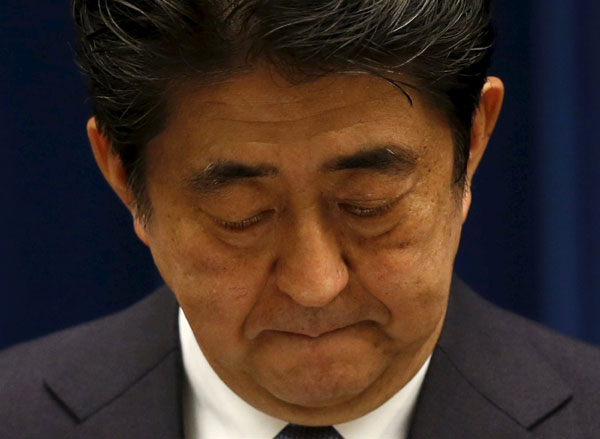
Japan's Prime Minister Shinzo Abe attends a news conference for delivering a statement marking the 70th anniversary of World War II's end, at his official residence in Tokyo, August 14, 2015. [Photo/Agencies] |
Japanese Prime Minister Shinzo Abe did mention "colonial rule", "aggression", "profound self-reflection" and "apology" in his speech on Aug 14 to mark the 70th anniversary of Japan's surrender in World War II, but he avoided endorsing the words that former Japanese prime minister Tomiichi Murayama used in 1995 to own up to his country's war past that helped Japan win the trust of some of its Asian neighbors.
Despite Abe's deliberate act of omission, some people both at home and abroad see his statement as a kind of "progress", with some even arguing that China should be more tolerant toward Abe in a bid to show its self-confidence.
In fact, the recent past has seen some people arguing that China should stop repeatedly asking Japan to apologize for its past atrocities because it could have the opposite effect on Japanese people and would thus be unfavorable to the healthy development of Sino-Japanese ties. Instead, they say, China should play down the unpleasant past and look to the future by recognizing Japan's contribution to postwar regional peace and development.
Such arguments may apparently sound appealing but are meaningless in reality, because Japan and its leaders have to give neighboring countries enough reason to shelve the past and look to a better future with Japan. The truth is Abe has not made even the slightest effort to eschew his rightwing leaning; rather he has been taking measures to revise history and offend all peace-loving people, including Japanese.
After Abe's Aug 14 speech, even some Japanese scholars said that, in essence, it violated the "Murayama Statement" despite not disproving it. And some Western scholars believe Abe's remarks reveal his intention to attribute Japan's invasion of Asian countries before and during WWII as a military action under pressure from Western powers. This, the Western scholars say, is a blatant attempt to cover up Japanese aggression by confusing it with "defense".
After the Aug 14 speech, the London-based Financial Times said Abe had failed to make an explicit apology for Japan's war past. And The New York Times, in an editorial, said Abe reviewed the stances taken by previous Japanese governments but was reluctant to fess up to Japan's past.
Abe believes Japan's "mistakes" and "crimes" do not include invading and occupying other countries, instead they lie in challenging the United States. Some other Japanese also believe Japan made a strategic mistake during the war by challenging the US. This shows they are least concerned about the atrocities committed by the Imperial Japanese Army before and during WWII. Given these facts, how can countries that suffered Japanese aggression extend a friendly hand toward Japan?
China should be confident about national rejuvenation. It has no reason to view the deepening US-Japan military alliance as a natural development. And it should not be self-confident about abandoning history.
China needs to adjust its Japan policy, but not its policy toward Japan's military past. Abe's argument that Japan cannot make repeated apologies for its war past is a ploy to influence domestic and international opinions and an attempt to shift the attention from Japan's attitude toward history to the diplomatic requirements of China and the Republic of Korea.
The history of East Asia is one of seeking justice. As such, the lack of sincere self-reflection on the part of Japan will make it very difficult to improve Sino-Japanese relations without Tokyo owning up to its military past.
The author is a researcher at the Australian National University. The article was first published on the ThePaper.cn.

Copyright 1995 - . All rights reserved. The content (including but not limited to text, photo, multimedia information, etc) published in this site belongs to China Daily Information Co (CDIC). Without written authorization from CDIC, such content shall not be republished or used in any form. Note: Browsers with 1024*768 or higher resolution are suggested for this site.
License for publishing multimedia online 0108263 Registration Number: 130349