 |
|
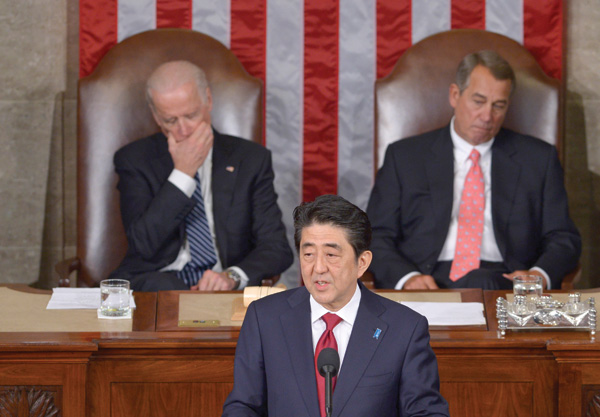
Japanese Prime Minister Shinzo Abe addresses a joint meeting of the US Congress in front of US Vice-President Joe Biden (left) and House Speaker John Boehner (right) on Capitol Hill in Washington on Wednesday. YIN BOGU / XINHUA |
Asian-American community leaders express annoyance at Japanese Prime Minister Shinzo Abe's speech at the US Congress on Wednesday and said the new defense guidelines might bring instability to the South China Sea.
Florence Fang, chairwoman of the Florence Fang Family Foundation and an entrepreneur and philanthropist in the San Francisco Bay Area, said she was "not only annoyed but irritated" by Abe's remarks that "Post war, we started on our path bearing in mind feelings of deep remorse over the war."
"Abe is a cunning sophist on this issue and he is playing with words. What is his remorse for? For their losing the war in 1945, the US dropping atomic bombs on Hiroshima and Nagasaki, or for the loss of 35 million Chinese lives during the eight-year Chinese war against Japanese aggression?" Fang said.
"Without a clear and unambiguous official apology from the Japanese government, there won't be real peace between China and Japan."
Fang is finalizing construction of a World War II in the Pacific memorial hall in downtown San Francisco, which is expected to open to the public on Aug 15, the 70th anniversary of the end of the Chinese People's War of Resistance against Japanese Aggression.
As for Obama's latest announcement that US is committed to protecting Japan and the two countries have updated their defense guidelines for the first time in 20 years, Fang said that "both the US and Japan are playing with fire, following a sinister agenda".
"In order to curb the growing influence of China in Asia Pacific and the world, the US keeps sending false signals to Japan, and now the two teamed up, a dangerous move that might bring more instability and complications to the troubled waters in the South China Sea," she said.
Austin Zhao, chairman-elect of Asian Chamber of Commerce, said the US government's current measurement is "short-sighted". "It looks like this will help the US rebalance the powers in Asia, to maintain stability, to restrain China; it's good in the short term. However, achieving that goal by relying on the not trustworthy Japan, it's irresponsible to the US and the world," Zhao said.
"In the end, the US might get hurt like it did in first supporting the Saddam Hussein regime of Iraq."
On the matter of apologies to East Asian countries for Japan's World War II-era conduct, Thomas Klitgaard, vice-president of the Chinese Culture Foundation and a Chinese legal expert and adjunct law professor at the University of San Francisco, said that from China's perspective, it is difficult to forgive Japan and move forward with a balancing of all the changes going on in both countries, and of interests in the region, without a sincere and complete apology from Japan's present leaders for its former leaders' wrongdoings in China in the World War II.
"I think that many Japanese people continue to appreciate the pain and suffering on both sides, and the loss of respect occasioned by the old military and government regimes of Japan in taking actions that were without respect for the Chinese and the Chinese culture and which failed to recognize that China and Japan had long been neighbors with many interests in common," he said.
"An apology would end the bleeding, which is still in progress from the Second World War, as recognized by the nearly 100-year-old former Japanese fighter pilot in a recent interview in The New York Times where he said that he still struggled with horrible dreams of seeing the terror on the faces of American torpedo plane pilots that he killed at the Battle of Midway in 1942.
"I think that from China's view, steps to peace and growth in the region going forward need recognition by Japan's present government that countries, including theirs, can make mistakes and that they can be forgiven," he continued.
"This is implicit in the preamble to Japan's constitution which condemns war as a way of solving problems."
Zhao said Japan is "short-sighted". "For the better-off of the world, East Asia and Japan itself, Japan should make a serious and sincere apology, like Germany did, to East Asian countries it wronged during World War II. Only then can Japan build trust with its neighbors. That would be good for Japan's future."
Richard Slemaker, publisher of Energy magazine said one important thing for Americans to understand is that "China was our ally in World War II; they helped our pilots and saved a lot of lives of our troops. Japan was our enemy, they sneak-bombed Pearl Harbor while they promised no attack in ongoing talks with the US."
"That's an act of terrorists, much like 9-11. For a government like that not to be trusted, it makes sense. In light of history, not only Americans should be wary, the Chinese should be wary, and Japanese themselves are wary. Trust issue is No 1. The US better be sure about the relations than just jump in," he said.
Nathaniel Ahrens, director of China affairs, University of Maryland; non-resident fellow, Center for Strategic and International Studies, said the main themes that emerged during Abe's trip are the US-Japan security relationship, the Trans-Pacific Partnership, and Japanese views of history.
This is a trip that is aimed primarily at a US audience, yet in all the critical issues, China looms large, Ahrens said.
"Though China is not mentioned by name, defense and trade objectives are couched in relation to China. And while Abe's commitment to uphold the views of contrition issued by former prime ministers regarding World War II may satisfy some critics in the US, it is unlikely to mollify those in Asia," Ahrens said.
Furthermore, he said Abe's oblique remarks about the wartime abuses to which women were subjected are also "unlikely to ease calls for a more clear apology relating to the role of comfort women".
June Chang and Lia Zhu in San Francisco, May Zhou in Houston and Cai Chunying in Washington contributed to this story.

Copyright 1995 - . All rights reserved. The content (including but not limited to text, photo, multimedia information, etc) published in this site belongs to China Daily Information Co (CDIC). Without written authorization from CDIC, such content shall not be republished or used in any form. Note: Browsers with 1024*768 or higher resolution are suggested for this site.
License for publishing multimedia online 0108263 Registration Number: 130349