|
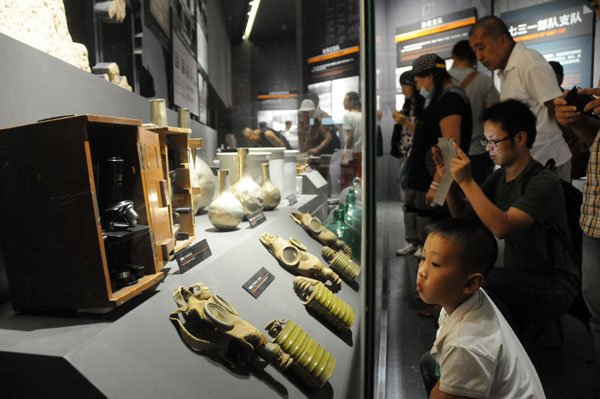 Visitors look at exhibits at the Museum of Evidence of War Crimes by Japanese Army Unit 731, in Harbin, Heilongjiang province, on Saturday, the day the museum opened to the public. Liu Yang / For China Daily |
A new museum in Harbin that explores the Japanese army's notorious human experiments in the development of germ warfare in China during World War II has opened to the public.
The Museum of Evidence of War Crimes by Japanese Army Unit 731 examines the top-secret biological and chemical warfare research base, established in 1935 as the center of Japan's biological warfare in China and Southeast Asia.
"According to the precious historical materials we found, at least 3,000 people, mostly Chinese civilians, died in the experiments between 1939 and 1945," said Jin Chengmin, curator of the exhibition hall.
"Outside the camp, thousands of Chinese - estimated at more than 300,000 - were killed by biological weapons produced in the laboratories of Unit 731," Jin said.
When the Soviet Union took Harbin, capital city of Heilongjiang province, in August 1945, the retreating Japanese invaders destroyed most of the facilities that produced germ weapons, which reportedly included bubonic plague, typhoid, anthrax and cholera.
The 10,000-square-meter building is divided into six exhibition rooms, displaying 10,050 relics excavated from the remains of Unit 731's headquarters.
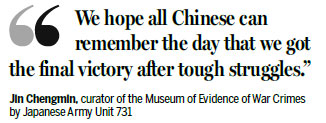
The museum's opening on Saturday aimed to coincide with the 70th anniversary of victory in China's War of Resistance against Japanese Aggression.
"On Aug 15, 1945, Hirohito announced Japan's surrender unconditionally," Jin said. "Seventy years later, we choose the same date to open the new museum because we hope all Chinese can remember the day that we got the final victory after tough struggles."
More than 1,500 visitors joined in the inauguration ceremony for the new museum. Among them, an elderly participant stood out in the uniform of the Northeast Anti-Japanese United Army.
"Peace does not come cheap," said 91-year-old Li Min. "We have to remember that not only innumerable soldiers lost their lives on the battlefield, but also so many underground workers and innocent people were killed here."
Masataka Mori, 74, a retired lecturer from Shizuoka University in Japan, had been researching Unit 731 since 1980. "We Japanese are the inflicters of the war and our elder generations are participants," he said. "I hope that through my research work we can find out the truth of history and face up to the wartime past."
In one exhibition section, Special Transfer, which refers to the secret transfer of Chinese patriots to Unit 731 for lethal human experimentation, Zhang Kewei, 74, found his father's name, Zhang Huizhong.
"There must be lots of families like mine," Zhang said.
The new museum took over the space of a former museum and significantly expanded the exhibit.
Contact the writer at zhouhuiying@chinadaily.com.cn

Copyright 1995 - . All rights reserved. The content (including but not limited to text, photo, multimedia information, etc) published in this site belongs to China Daily Information Co (CDIC). Without written authorization from CDIC, such content shall not be republished or used in any form. Note: Browsers with 1024*768 or higher resolution are suggested for this site.
License for publishing multimedia online 0108263 Registration Number: 130349