Q: What kinds of biological warfare did the Japanese Army carry out in China?
A: Japan began research on bacteriological weapons in the 1920s. In April 1932 the Japanese Army set up a bacteriological laboratory at its Military Medical School in Tokyo under the leadership of Shirō Ishii. In August Ishii transferred the research on bacteriological warfare to Heilongjiang Province in China and built a bacteriological laboratory in Beiyinhe, Wuchang County. In the spring of 1936, the laboratory was moved to Pingfang District, Harbin, and was officially referred to as the "Anti-Epidemic Water Supply and Purification Bureau of the Kwantung Army." In 1941 the Bureau adopted the name "Unit 731 of Manchuria."
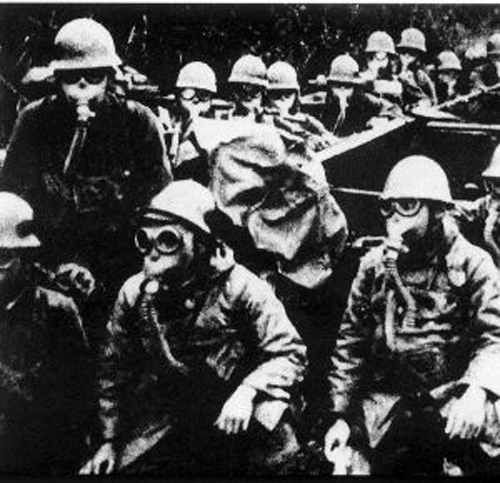
In China the Japanese Army set up six biological and chemical warfare units that involved a total of more than 20,000 troops. These units were Unit 731 in Harbin, Unit 100 in Changchun, Unit 516 in Dunhua, Unit 1644 in Nanjing, Unit 1855 in Beiping, and Unit 8604 in Guangzhou.
Unit 731 carried out a large number of experiments, the most horri?c of which were conducted on live human beings, who were referred to in Japanese as "maruta" ("logs"). Those conducting the experiments performed vivisections on living subjects, injected subjects with pathogens, experimented with gas and poison, carried out electrical experiments, and infected subjects' food and water. In order to observe and test the efficacy of bacteriological and chemical weapons, Unit 731 would often tie the "maruta" to stakes in the testing ground, making them suffer the effects of bacteriological and chemical bombs dropped by airplanes or fired from artillery, and even directly administered plague-infected ?eas or gas to them.
Germ warfare was an important part of Japan's war against China. In July 1940, Shirō Ishii directed a germ warfare unit in battles at Ningbo and Jinhua. As a result, bubonic plague spread throughout local communities. Several thousand people became ill, and hundreds of people died.
In the summer of 1941, Colonel Ota Kiyoshi, chief of the 2nd Department of Unit 731, led a germ warfare unit to Changde in Hunan Province to support army operations. This unit dropped plague-infected cotton fibers, fabric cuttings, wheat, rice, and fleas from the air over Changde, causing an outbreak of bubonic plague in the area and at least 7,600 deaths.
In the Zhejiang-Jiangxi campaign from May to September 1942, supported by Unit 1644 from Nanjing, Japanese troops dispersed anthrax, paratyphoid, and bubonic plague germs from airplanes, resulting in outbreaks of bubonic plague and heavy casualties in the targeted areas.
In May 1942, Japanese troops carried out attacks with cholera bacteria against Baoshan and Kunming, causing outbreaks of cholera in 58 counties and cities in Yunnan Province. Within a period of two and a half months, more than 120,000 people had become ill and more than 90,000 had died. From the fall of 1944 to March 1945, Japanese troops disseminated plague bacteria across western Yunnan. The resultant outbreaks of bubonic plague lasted until 1953.
In August 1945, Unit 731 soldiers blew up all their facilities, destroyed all equipment and materials used in their experiments, and secretly killed hundreds of imprisoned "maruta."

Copyright 1995 - . All rights reserved. The content (including but not limited to text, photo, multimedia information, etc) published in this site belongs to China Daily Information Co (CDIC). Without written authorization from CDIC, such content shall not be republished or used in any form. Note: Browsers with 1024*768 or higher resolution are suggested for this site.
License for publishing multimedia online 0108263 Registration Number: 130349