On Monday, nearly 150 countries will gather in Paris, not just in defiance of the ISIS terrorist threat, but more in a joint effort to combat global climate change, one of the gravest challenges facing humanity. Their determination to reach consensus at the Paris Climate Change Conference, also known as the COP21, and follow with concrete actions will have far-reaching impact on the success of mankind to create a sustainable future for generations to come.
|
 |
|
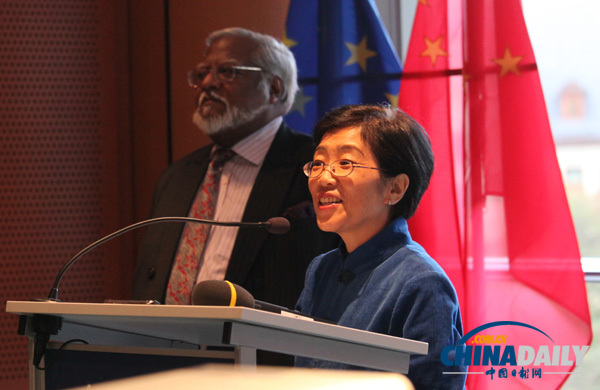
Yang Yanyi, Head of the Chinese Mission to the EU is seen in this file photo taken in October of 2014. [Photo by Fu Jing/chinadaily.com.cn] |
China and the EU are amongst the most active and critical players in tackling climate change and preparing for the COP 21. Both are effectively embarking on sustainable, resource efficient, green, low-carbon and climate resilient development and working constructively together at bilateral and international level for ambitious climate actions.
The 13th Five Year Plan highlights the goal of China to nurture an open and innovation-driven economy featuring inclusive, green and coordinated growth, which will enable China to better address climate change in the next five years. Prior to this, China has already been working proactively to ensure the full, effective and sustained implementation of the United Nations Framework Convention on Climate Change Convention. Up till the end of 2014, China has reduced GHG emission per unit of GDP by 15.8% compared with 2010 levels. Pilot emissions trading systems have now been operating smoothly in seven regions to prepare for the launch of the nationwide carbon market in 2017 covering key industry sectors. The ratio of non fossil fuels has now accounted for 11.2%of the total primary energy supply. Statistics released by the World Bank demonstrate that in the past two decades, energy saved by China has accounted for 52% out of the world’s total. IEA reports recognize that China has contributed almost 40% to the increase of the global renewable energy capacity and helped to cut by half the cost of wind power and photovoltaic power generation.
Additionally, China has already submitted its Intended Nationally Determined Contribution, committing to peak GHG emission by 2030 at the latest, lower the carbon intensity of GDP by 60% to 65% below 2005 levels by 2030, increase the share of non-fossil energy carriers to around 20% by that time, and increase its forest stock volume by 4.5 billion cubic meters, compared to 2005 levels.
Being as the largest developing country, China is devoted to helping the rest of the developing world. China has set up a US$ three-billion fund to help other developing countries to combat climate change. In the past three years, China has provided US$ 62 million financial support to developing countries to improve energy efficiency and use of renewable energy,and helped to train over 1000 officials and technicians from over 120 developing nations in capacity building.
The EU is also a strong advocate for the Convention. It has adopted at European level a comprehensive package of policy measures - the European Climate Change Programme (ECCP) - to reduce greenhouse gas emissions. Each of the EU member states has also put in place its own domestic actions that build on the ECCP measures or complement them. So far, the EUhas reduced GHG emission by 17.9% compared with 1990 levels and planned to cut the emission by 20% by 2020 and 40% by 2030.
China and the EU have maintained frequent mutual exchange on climate change policies, planning and good practices for low-carbon and climate resilient cities. They have been successfully cooperating on building emission trading capacity, collaborating on climate-related scientific research and technology innovation, including the development and deployment of low-carbon technologies and adaptation solutions. Their shared commitment and vision brings them to significantly enhancing their partnership on climate change established in 2005 and building on a decade of successful cooperation. The synergy of China’s One Belt and One Road Initiative with the Juncker plan and the establishment of the connectivity platform will enable the two to elevate their cooperation on climate change and co-produce tangible results in developing a cost-effective low-carbon economy, launching a Low-Carbon Cities Partnership, enhancing climate resilient investments, exchanging and exploring more policy instruments in terms of energy conservation and energy efficiency.
Their cooperation is not limited to the bilateral level. China and the EU have reinforced their coordination and cooperation in the framework of the UNFCCC, and other relevant fora such as the G20, MEF, Montreal Protocol, ICAO and IMO. The two partners have reaffirmed their commitment to reaching an ambitious and legally binding agreement in Paris that enhances the implementation of the Convention on the basis of equity and reflecting the principle of common but differentiated responsibilities and respective capabilities, in light of different national circumstances. They have also called for the developed countries to provide and mobilize jointly USD 100 billion per year by 2020 to address the needs of developing countries.
And there is still more that can be done.Apart from securing joint statements on climate change with the EU, France, the US, India and Brazil prior to the Paris, China has been coordinating intensively with the other BASIC and LMDC countries as well as members of the G77 to narrow down the differences. The EU canleverage its impact by taking the lead among developed countries in fulfilling their emission reduction targets and providing financial and technical support to developing countries. China and the EU should continue to uphold the principle of common but differentiated responsibilities and respective capabilities on the basis of equality, with a view to facilitating a comprehensive, balanced and ambitious pact in Paris. They should continue to enchant green and low-carbon development worldwide and call forstronger global climate action to ensure the full, effective and sustained implementation of the Convention now, up to and beyond 2020.
Much has changed after Copenhagen. The challenge of climate change has never been so imminent. Luckily enough, the international community has never been so close to reach consensus. There is no reason for China and the EU to stop working closely together tocontribute to the global efforts to make COP21 in Paris a new milestone in combating climate change.
The author is Ambassador Yang Yanyi, Head of the Chinese Mission to the EU

Copyright 1995 - . All rights reserved. The content (including but not limited to text, photo, multimedia information, etc) published in this site belongs to China Daily Information Co (CDIC). Without written authorization from CDIC, such content shall not be republished or used in any form. Note: Browsers with 1024*768 or higher resolution are suggested for this site.
License for publishing multimedia online 0108263 Registration Number: 130349