A decline in coal use, due to the economic slowdown, may warm the hearts of environmentalists, but the sector that produces the traditional heat source may be feeling the chill.
As the largest coal burner in the world, China's coal use last year fell by 2.9 percent from 2013 levels. In the first half of this year, the nation saw a 5.8 percent fall in coal use, followed by a 4 percent fall in the third quarter, according to energy specialists.
For all of this year, China may see a 4.3 percent reduction in coal use compared with last year, said Han Xiaoping, CEO of China5e.com, an energy information website.
|
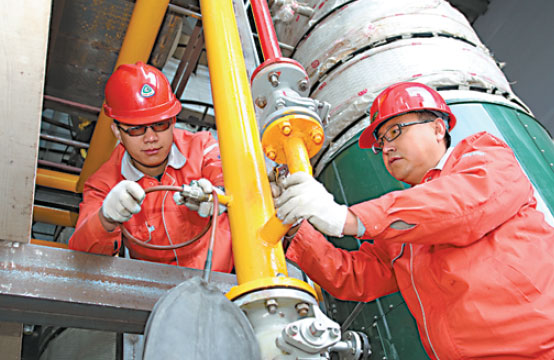
Workers at a gas company in Zhangjiakou, Hebei province, carry out the final test on a gas-fired boiler. The city is gradually reducing its reliance on coal to power boilers. Bai Mingshan / Xinhua |
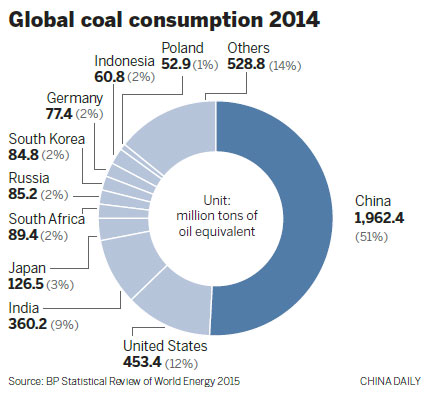
In the first three quarters of this year, global coal use fell by between 2.3 and 4.6 percent, according to environmentalists. China, which cut its coal imports by as much as 31 percent, was a key contributor.
Last year, the nation's annual coal use was 1,962.4 million tons of oil equivalent - 51 percent of the global total.
Lin Boqiang, dean of Xiamen University's Institute for Studies in Energy Policy, said that not surprisingly this is having an effect on coal mines' balance sheets.
Lin said most mines will face even more difficulties if more stringent environmental standards are applied.
China no longer faces an acute energy shortage, Lin said, adding that increasing efficiency is now the priority.
Experts predict that China's carbon emissions will stop rising before 2030 - the scheduled peak time for greenhouse emissions - as part of the country's goals in a prospective global climate agreement expected to be signed in Paris.
In a recent survey conducted by nonprofit organization China Carbon Forum, 80 percent of the respondents - mainly China-based specialists and businesses - expected this target to be met sooner.
"The slowdown is softening dependence on coal-fired power and leading a shift to clean and renewable energy," said He Jiankun, director of Tsinghua University Institute of Low Carbon Economy.

This is paving the way for emissions to peak, He said, "as long as we don't run too fast and keep our growth rate below 7 percent".
Gerard Wynn, a consultant at GWG Energy, said that based on a growth forecast by the Organisation for Economic Cooperation and Development, China's emissions might peak between 2020 and 2026.
Official data show that last year China's carbon dioxide emissions per unit of GDP dropped by 33.8 percent from the level in 2005. Major industrial operations cut energy use, especially in power generation and in the materials sector.
According to the BP Statistical Review of World Energy 2015, while coal remains the dominant fuel, the gap between coal and renewables is narrowing, albeit gradually.
Use of renewables grew by 15.1 percent over the year, during which time nuclear power grew by 13.2 percent, more than doubling production over the past 7 years.
By last year, the installed capacity of hydropower had risen by 2.75 times and on-grid wind capacity by 90 times from levels in 2005. Dramatic increases were also seen in solar power capacity, which rose by 400 times from 2005 levels, and nuclear power, which increased by 2.9 times.
Environmental experts and economists say the future depends on a number of factors.
These include whether conversion from coal use proceeds well without incurring too high a cost or causing too much trouble in the labor market, and whether the central government's policies can be implemented by all local governments.
According to a policy paper released by the National Development and Reform Commission at the end of last year, annual coal use in 2017 needs to be cut by 13 million metric tons in Beijing, by 10 million tons in Tianjin and by 40 million tons in Hebei province from 2012 levels.
Four other provincial-level entities in Yangtze and Pearl River Delta areas must soon come up with their targets to reduce coal use.
wangyanfei@chinadaily.com.cn
(China Daily 12/01/2015 page2)

Copyright 1995 - . All rights reserved. The content (including but not limited to text, photo, multimedia information, etc) published in this site belongs to China Daily Information Co (CDIC). Without written authorization from CDIC, such content shall not be republished or used in any form. Note: Browsers with 1024*768 or higher resolution are suggested for this site.
License for publishing multimedia online 0108263 Registration Number: 130349