 |
|
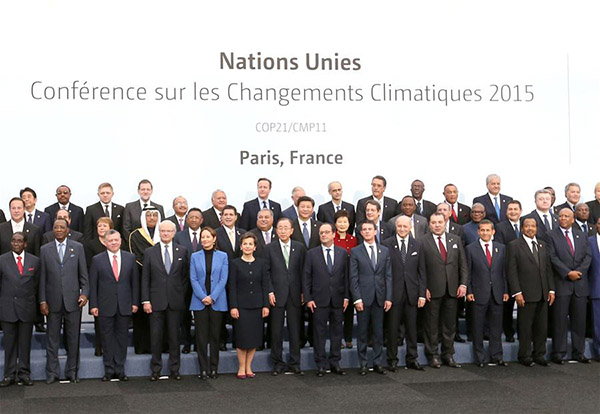
Chinese President Xi Jinping (8th L, 2nd row) poses for a group photo with other participants during the United Nations (UN) climate change conference in Paris, France, Nov. 30, 2015. [Photo/Xinhua] |
In tightened security in Paris where the two-week United Nations climate change summit is being held, China's President Xi Jinping urged the world leaders to abandon zero-sum mindset in battling against the global threat and achieve what observers say is a "widely-accepted but not satisfying" historic agreement to reduce the earth's carbon emissions after 2020.
Xi spoke at the opening of the talks, in the presence of up to 150 global leaders including US President Barack Obama, who has already met the Chinese president and issued two joint presidential statements in 2014 and in September this year to solidify the consensus within the biggest economies and carbon emitters.
The observers say Xi and other global leaders' strengthened commitments mean their negotiation teams have flexibility and more room to compromise in order to achieve a deal, which could be "accepted by all parties but may not be satisfying for all." They say this is normal in any international negotiations.
The final deal is scheduled to be reached on December 11 if talks are on the right track, while the draft text will be ready on December 4.
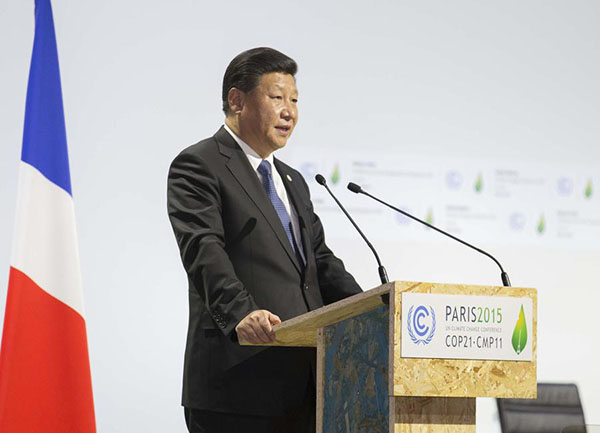
"The Paris conference should reject the narrow-minded mentality of a zero-sum game," said Xi, adding that the Paris climate conference should yield positive and practical results with a comprehensive, balanced, ambitious and binding agreement.
Xi also said that tackling climate change is a shared mission for mankind and that global efforts on climate change are like a mirror reflecting a model for future global governance.
The principle of "common but differentiated responsibilities" should be adhered to, the president said, and the conference should create a win-win future, with each country contributing to the best of its ability and with countries being allowed to seek their own solutions.
Xi joined other leaders in trying to break the deadlock on financing in the UN climate negotiations and to bring real money to the table, while urging rich countries to honor a commitment of a $100 billion climate fund each year by 2020 and to provide strong support to developing countries afterward.
 |
|
President Xi Jinping delivers a speech for the opening day of the World Climate Change Conference 2015 (COP21) at Le Bourget, near Paris, France, November 30, 2015.[Photo/Xinhua] |
Meanwhile, it's also important that climate-friendly technology should be transferred to developing countries, he said in his ten-minute address.
China pledged 20 billion yuan ($3.1 billion) to establish the South-South Cooperation Fund on Climate Change to support other developing countries in coping with climate change.
Xi also said the ecological projects will be featured prominently in China's 13th Five-Year Plan (2016-20). He said China will help developing countries set up 10 low-carbon pilot zones from 2016.
Dennis Pamlin, founder of Sweden-based consultancy 21st Century Frontiers says Xi has set an example for other global leaders in expressing their commitments in dealing with climate treat.
"Xi's calling to abandon the zero-sum mindset worldwide, if others have heard and taken actions, is perhaps the most important change that must happen in the global climate work," said Pamlin.
In achieving it, Pamlin said this requires the world to rethink many of the current tools and governance structures, from offsetting to carbon taxes, and also to challenge many of the old polluting companies that today are very reluctant to reduce emissions.
"We need to focus more on companies that see reduced emissions as a business opportunity. Citizens should be the focus, not old companies unless they can show how they help citizens live better lives with zero-emissions in the near future," says Pamlin.
Samantha Smith, leader of WWF's Global Climate and Energy Initiative, described Xi's stance as a good call to all governments to recognize that climate change is a global crisis and requires a collective and global effort.
"If countries only consider their own national interests and are not willing to compromise this will only result in a winners-losers scenario which is not in the interests of the common future of humanity and the planet," said Smith.
As to Xi's asking for developed countries to make good on their commitment to help poor countries, Pamlin said there are two barriers.
One real barrier is that many countries today are in a difficult economic situation. "The second barrier is a tactical one. Developed countries feel that as soon as they pay something there are many other things that developing countries ask for," he says.
"As developed countries have not done a good job in delivering on their promises, tech transfer and better trade policies in relation to developing countries they want to wait as long as possible to focus the negotiations around a relatively simple issue."
Pamlin said China's leadership in the South-South cooperation is very promising and if the quality of the projects are high this should be a role model for the global cooperation.
"It is clear that China now has a central role to play and is willing to take bold and necessary actions. With focus in the positive opportunities, while recognizing the need to reach the necessary reductions, China has a very good approach," Pamlin said. "How this will be followed up during the G20 (Chinese) presidency will be interesting to see."
Smith of the WWF said it is clear that without the fulfillment of commitments made by developed countries, including the financial commitments, trust between countries will not be built. Thus far, Smith said the $100 billion commitment has not been met and without the delivery of this, it would be difficult for developing countries to accept that the commitments that will be made in the new agreement of finance after 2020 will be met.
Smith also said that announcements on South-South cooperation by China are an important signal that developing countries with the capacity can provide support to other developing countries to deal with climate change and transition to low carbon sustainable future. This kind of solidarity and collective action is critical now.
"We believe that all high level signals from leaders committing to address climate change is critical in this period of urgency," said Smith. "President Xi's statements of commitment to reaching an agreement in Paris is an important contribution to creating the political momentum and will and should help encourage other leaders to be ambitious and part of the collective efforts to deal with climate change."
Bill Jones, chief Washington correspondent for the Executive Intelligence Review and Senior Chinese Scholar at the Schiller Institute in Washington said President Xi clearly underlined the point that all the countries have a responsibility in dealing with this issue.
"He also made it clear that it wasn't simply a one-size-fits-all situation. He also made clear that each country, in making its contribution, had to take consideration to their own particular situation in their attempt to move away from fossil fuels," said Jones.
Jones also said that the South-South Fund established by China will be of great importance to the developing countries in resolving some of their environmental problems.
"President Xi emphasized that the effort to combat climate change must not impinge on the developing countries' need for continued economic growth. This attitude is in stark contrast to the zero-growth mentality characterizing most international climate institutions," said Jones.
Jones said President Xi hit the right tone in his speech. "We are dealing with a problem which mankind can resolve without sacrificing its future," said Jones. " I think that the tone that he set in his remarks will be greatly appreciated, especially by the developing countries, which are most gravely effected by changes in the climate precisely because of the long period in which they were not allowed to develop."
In climate fund transfer to the poor countries, Pierre Calame, president of the China-Europa Forum Foundation in Paris said for there are several barriers, but the most important one is the way to finance it.
"There is indeed a very simple way: a global tax on the extraction of fossil energy from rich countries and this is more efficient than a carbon tax at the moment energy is used," he said.
"This tax could easily been channeled towards the efforts of the least developing countries to move in the direction of a new sustainable development model," said Calame.
Jon Gibbons, director of the UK CCS Research Center said China is well placed to take a leading role in global cooperation between developed and developing countries to fight climate change using carbon capture and storage, based on its impressive power plant construction industry.
"It is also clear that China is committed to playing its part in seeing that the world avoids dangerous climate change - this is essential to preserve the well-being of people in China just as much as in countries where development has occurred earlier," said Gibbons. He also said President Xi's vision of Paris as the start of a new process is very constructive.
Tom Jennings, Director of?Policy and Markets of the London-based Carbon Trust said climate change is a global problem that needs global solutions and thinking only about national interests will not deliver the urgent progress that is required to limit warming to no more than 2 degrees.
"Xi Jinping is right to highlight the importance of developed nations helping developing nations through providing finance to invest in addressing climate change," said Jennings.
"China is already a world leader in a number of clean technologies, so it has an important part to play in bringing down the cost of clean energy."
Jennifer Morgan, Global Director, Climate Program, World Resources Institute issued a statement that said President Xi is showed his resolve to address climate change and reach a strong agreement, with all countries taking action.
"His comments show that China is ready to step into a pivotal role in reaching common ground on key issues here in Paris," said Morgan. "Xi embraced China's role of the largest emerging economy to help developing countries to tackle climate change via south–south cooperation, providing financial, technological and capacity building support."
Michael Schack, Project Leader of Heating and Cooling Networks and Cogenerations of French energy giant ENGIE also believed that other global leaders should follow China's example to inject more concrete political will to achieve a Paris deal.
Jean-Pierre Lafon, French ambassador to China said he has realized tremendous changes in China in improving environment and climate awareness and technology breakthrough.
"China has taken firm actions in tackling pollution and climate threat," said Lafon.

Copyright 1995 - . All rights reserved. The content (including but not limited to text, photo, multimedia information, etc) published in this site belongs to China Daily Information Co (CDIC). Without written authorization from CDIC, such content shall not be republished or used in any form. Note: Browsers with 1024*768 or higher resolution are suggested for this site.
License for publishing multimedia online 0108263 Registration Number: 130349