


Energy deal creates a formidable force
By Damian Chunilal ( China Daily Europe ) Updated: 2014-06-27 07:31:35After a long wait, talk of stronger relations turns into reality
When Russia recently signed the 30-year, $400 billion (294 billion euro) deal to supply gas to China, officials greeted the close of the long-running negotiation with a mix of relief and delight.
The fact that both sides have been able to put to aside past differences and strike such a large and significant deal could be a marker of a far more important and long-term shift for the countries' bilateral relations and perhaps the balance of the global economy.

Closer ties between Moscow and Beijing have been expected for years - long before current regional challenges. Russia has been looking eastward to diversify its energy export base in the face of Europe's expected efforts to reduce dependence on Russia, which accounts for 24 percent of its gas.
Last year, the Russian government announced a new foreign policy concept that noted the importance of stronger relations with China and India. The intent is clear, and this deal shows that words are now turning into reality.
China may have played a good hand in negotiations at a point when Russia's appetite was at its peak, but it also had equally strong incentives to get the deal done. After all, it can take up to 35 days to deliver China's imports of mineral resources from Australia, Brazil and South Africa. Siberian resources are abundant and take only four days to transport. A deal like this lays the ground for further natural resource partnerships, expanding import and export markets for both countries.
China remains one of the biggest Russian trade partners. The key indicators such as foreign direct investment - one of the main indicators of bilateral economic relations - have been historically low. But this is changing. Between 2008 and 2012, trade grew at 17 percent annually. This is expected to increase even more as a result of plans to boost FDI through a special vehicle created between the Russian Direct Investment Fund and China Investment Corporation. The Russian government has also said it intends to grow bilateral trade to $200 billion by 2020.
Further evidence of increased collaboration can be found in recent partnerships between China and Rosneft, the oil company majority owned by the Russian government. Rosneft received a $2 billion loan from the China Development Bank last year, and agreed to a $270 billion supply deal with China National Petroleum Corp, including a $70 billion pre-payment to Rosneft. Russia is looking to secure more Chinese funding - particularly as it has long depended on exposure to Western debt - but also because its equity markets would benefit from increased demand to bolster prices and recover from recent shocks.
Russian banks are also more active in the Chinese market, with VTB Capital, Russia's leading investment bank, recently being mandated as a joint lead manager and joint book runner on the placement of a $300 million high-yield bond issue for Logan Property, a leading Chinese real estate company.
And since corporate parent VTB Group became the first emerging market issuer outside China of dim sum bonds denominated in renminbi four years ago, further advances have been made in ruble-renminbi settlement. Volumes have steadily picked up as bilateral trade has grown, and trade contracts are increasingly being signed in local currencies.
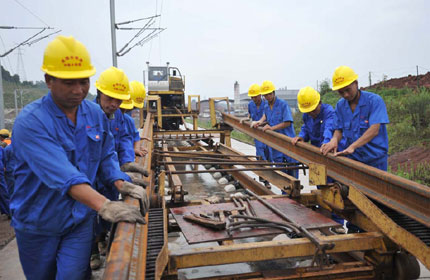
Moscow has long been resistant to allowing Chinese investment in strategic infrastructure projects, but that is starting to change as well. Russia's state-owned United Aircraft Corporation and China's Comac signed a memorandum to cooperate on creating a long-distance airliner to compete with Boeing and Airbus. Also, increased links can be seen in the governmental Russian Direct Investment Fund's construction of a railway bridge across the Amur River between China and Russia.
Both countries share common needs. Demand for energy is rocketing, especially in China, which is expected to reach 7.5 percent GDP growth this year, still far outstripping the eurozone and the United States. But the countries also share a growing middle class demanding better infrastructure and regional development.
The aftershocks of the global financial crisis have made a dependence on Western export markets less attractive than before. Export and trade diversification has therefore not only become more politically expedient, but a necessity of a changing global economic landscape.
Whether it is pragmatism, opportunism or something more profound in Sino-Russian relations, further development toward closer collaboration seems inevitable. The work to realize stronger trade and economic ties has begun with the recent Gazprom deal, and this may just be the start of a genuine shift in the global economic center of gravity if other bilateral partnerships can be nurtured.
The author is the CEO Asia for VTB Capital, Russia's leading investment bank. The views do not necessarily reflect those of China Daily.


|
|

|
|


|
|


|
|












European Weekly
 We will not give up search, Li vows
International hunt for missing airliner continues after fruitless six-day search

