New world order is the inevitable trend







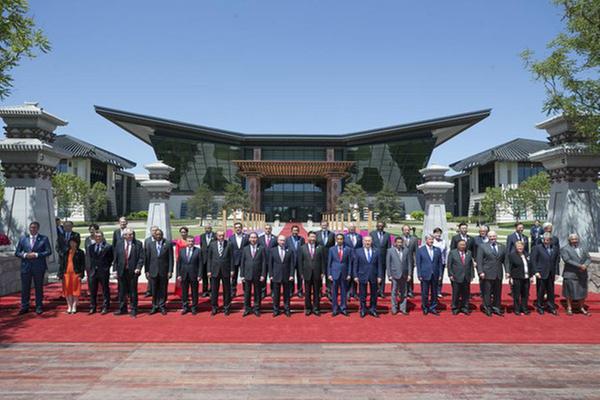 |
| President Xi Jinping, foreign delegation heads and guests pose for a group photo at the Leaders' Roundtable Summit of the Belt and Road Forum for International Cooperation at Yanqi Lake International Convention Center in Beijing, May 15, 2017. [Photo/Xinhua] |
After decades of turbulence, the world order led by the United States has begun to change, with the 2008 global financial crisis possibly being the turning point and this year signaling a new beginning.
On the global front, the strength of developing countries has greatly increased. For example, China has been playing a greater role in global governance to build a "community of shared destiny", as propounded by President Xi Jinping.
And the International Monetary Fund has predicted the share of high-income countries in the global purchasing power parity-based GDP will drop from 64 percent to 39 percent, with Asian emerging powers' share increasing from 12 percent to 39 percent, with China taking 21 percent.
The changing world order is not about the decline of the US but about the rise of other countries, as Fareed Zakaria, a CNN journalist and author of The Post-American World, said. Nevertheless, global governance is set to change from West-led governance to co-governance by the West and East, as the democratization of international relations is a wish shared by all countries.
A multipolar world order and globalization will be the highlights of the new era. Countries across the world are willing to compete and cooperate on the basis of fairness and justice, yet the deadlock between emerging powers and the established ones will continue for some time.
The changing world order has also caused uncertainty, instability and increased geopolitical risks, especially because the US still practices "American exceptionalism", worrying about the rapid rise of emerging countries. As a result, the US has been more vigorously implementing the "rebalancing to the Asia-Pacific" strategy, and complicating the Korean Peninsula nuclear and South China Sea issues.
Another feature of the changing world order is the intensification of conflicts between countries that support and oppose globalization. Interestingly, the roles of countries in pushing forward globalization have changed: Developing countries such as China firmly support globalization while some Western countries such as the US, who initiated the process of globalization, are opposing it now.
Washington is also trying to change the global economic rules which it considers harmful to US interests. From the Trans-Pacific Partnership agreement that former US president Barack Obama energetically pushed forward to the "America First" policy of incumbent President Donald Trump, the US' focus has been to increase its own benefits. The fact, however, is that only when they cooperate with others can they benefit from each other to have a win-win outcome.
What the Trump administration refuses to accept is that the rejection of globalization will destabilize the world in a long run. In contrast, to strengthen globalization, China has proposed projects such as the Belt and Road Initiative and a community of shared destiny.
Moreover, the concept of regional and global security, too, is changing. As such, despite the existence of competitive military alliances and global security partnerships, eventually all countries have to cooperate to seek common security and peace.
After the end of World War II, the US entered into many bilateral and multilateral military alliances to maintain its supremacy, based on which a global security system led by it was built. But in the changing world order, it is difficult for the US-centric military alliances to maintain world peace or ensure the US' own security. According to a Pew Research Center poll across 37 countries, global trust in the US has been declining sharply.
Still, as a pillar of the US' global strategy, Washington's military alliances will not end in the short term; instead, they could gain in strength.
Even the developing new world order will create some challenges related to globalization and geopolitics that will continue to bother the international community. The urgent need is for all countries to make sincere efforts to achieve peaceful development. And China, as a responsible power, will keep pursuing the path of peaceful development and win-win cooperation to help make the world a better place for future generations.
The author is former Chinese vice-foreign minister and co-chairman of the Center for China and Globalization.